
Original site in English

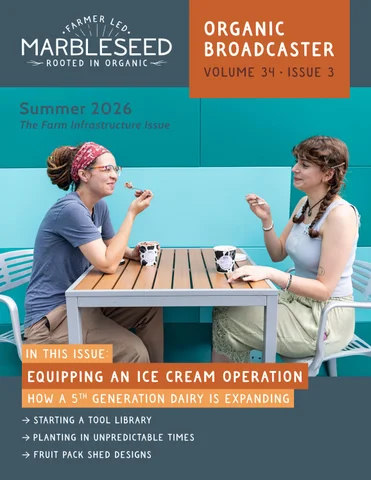
Organic Broadcaster: Summer 2026

Volume 34 Issue 3

Summer 2026


In This Issue

Equipping an Ice Cream Operation: How a 5th Generation Dairy is Expanding

Klemish Farm in New Auburn, WI, has been family-owned since 1889. It’s now run by the fourth and fifth generations – Randy and Dixie Klemish and their son and daughter-in-law, Joe and Trista Klemish. They are forging a new path for their operation, adding ice cream and cheese, along with the milk they continue to sell to a local cooperative.

by Marbleseed
Accelerating Sustainable Agriculture Practices: The longtime effort to engage women landowners

“The opportunity is so big you could drive a Mack Truck through it,” says Jodi Enos-Berlage, a microbiologist, educator, and landowner in northeast Iowa.

by Jennifer New

Planting in Unpredictable Times Too wet, too cold – what else is new?

This spring saw another undesirable weather pattern in the Upper Midwest. March had some well above normal temperature days. April was also mild, although will be remembered more so as very wet. Rainfall totals for April in my area near DeKalb, IL, ended up in the seven to nine inches range – more than double the monthly precipitation average.

by Dave Campbell, Lily Lake Organic Farm

Summit on Farmer Risk: A Space for Movement-Making

This spring, Marbleseed convened an eclectic group of folks to discuss farmer risk. The Summit on Farmer Risk: Investing in a Comprehensive Farm Safety Net for Human Scale Organic Farms, occurred in Chicago, IL, on April 16, after more than six months of planning.

by Lori Stern, Marbleseed Executive Director

Fruit Pack Shed Designs: Setting yourself up for success

The process of growing apples looks pretty similar across orchards. Trees are set up in blocks, either free-standing or on a trellis. There is a strict spray and management schedule to counter pests and diseases. In late summer and autumn, the apples are hand harvested.

by Tay Fatke

Food Safety Considerations for Wash Pack Sheds

Packing and wash sheds come in all shapes and sizes, as does the equipment that comprise them. Many beginning and small farmers find this aspect of building an operation intimidating as it means understanding food safety.

by Annalisa Hultberg, University of Minnesota Extension

Building A Tool Library: Advice from Sam Oschwald Tilton

Two thousand dollars. That’s how much farmer Vang Lee figures he has saved by belonging to a tool library. He is part of a group of farmers, many of whom are Hmong Americans, who farm at Fondy Farm north of Milwaukee. Last year, the Fondy Food Center, which oversees the farm as part of its work to provide local, healthy, and culturally relevant good the greater Milwaukee area, started the tool library to help farmers access more equipment and expand their farming capacities.

by Q & A with Sam Oschwald Tilton, Glacial Drift Enterprises

USDA Rips $300 Million Away from the Next Generation of Farmers

In 2021, I turned every inch of my property into food production and pollinator habitat. It's a small lot in Saint Paul, MN, but we are able to produce organic eggs and produce for our family and neighbors at a sliding scale cost. Our dream is to grow it into a robust, profitable operation. I own my home and two successful small businesses. I'm a Master Gardener and graduate of Land Stewardship Project's Farm Beginnings Program. I have relationships with farmers and farmland owners across the Midwest. But I cannot afford farmland.

by Amanda Koehler, Amanda Koehler Consulting LLC

Funding Farm Infrastructure: Focus on Finances

When I talk to farmers about their businesses, debt is a common topic. And the context is usually that the farmer wants nothing to do with it.

by Anna Thomas, Food Finance Institute

Growing Community, Deepening Cultural Roots

Intergenerational learning. Collaborating across continents. Cross-global sharing. Cultural pride. These are all central tenets of the Sudanese Farming Group. The group (SFG for short) was formed in 2022 by a small group of Sudanese immigrants, all of whom were non-farmers. They saw farming as a chance to preserve and recover cultural practices through food. Today, working on two different farms, up to 40 families are involved in planting, harvesting, and sharing food together.

by Marbleseed

Download PDF