

Accelerating Sustainable Agriculture Practices: The longtime effort to engage women landowners
By Jennifer New
Publication
Summer 2026
Ri venest eveniendit as quisit fugit quiam, te pore por aceaque es seris re quistotatet qui.
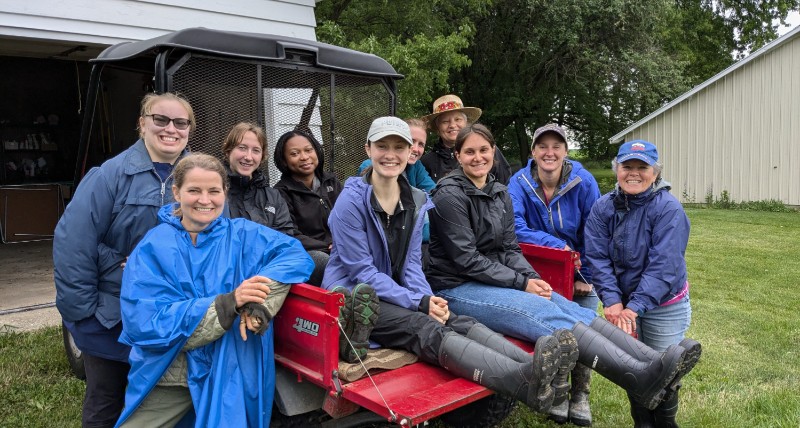
“The opportunity is so big you could drive a Mack Truck through it,” says Jodi Enos-Berlage, a microbiologist, educator, and landowner in northeast Iowa.
If soil fertility is at the center of the equation for improving water quality, providing healthy food, and strengthening rural communities, then the people ultimately responsible for soil health must be part of the solution. Whether they farm or not, it is landowners, Enos-Berlage believes, who need to show up as stewards.
In Iowa today, nearly half of landowners are women – a percentage on par with the national average. Many of them own but do not operate on their land. They lease it to farmers, the majority of whom are male.
These women are the opportunity Enos-Berlage and others have come to see as a vital part of any agricultural and climate solution. Studies show that women have different priorities when it comes to land than their male counterparts. As a group, they are more concerned with conservation and community, while less devoted to the bottom economic line. Reach women landowners and there’s a real possibility of creating authentic and scalable on-the-ground change.
No more space on the map
Enos-Berlage experienced an obstacle to this line of thinking when in 2014 she was approached by a group of concerned farmers who were interested in cleaning up a local creek that ran through the campground in Decorah, IA. It was frequently accessed by families with children as a place for water play.
The stream had high levels of bacteria, and they hoped the professor at Luther College with expertise in microbiology could help. It was an easy sell. She and her husband own and operate a small local farm, the runoff from which flows into the stream. Enos-Berlage was also familiar with farming, having grown up on a purebred cow/calf/conventional crop farm in Illinois.
“We were a year into water monitoring,” she recalls of the project, “and we had evidence of when and where bacteria was showing up. Our data helped us get a state cost-sharing grant to do outreach to farmers in the watershed.”
The group created a flyer aimed at farmers that announced potential conservation funding. To figure out who to send it to, they used a plat map to identify farm locations and names of owners. While helping address envelopes, Enos-Berlage had an aha moment: “I live in the watershed, but I realized I wasn’t going to get one.” It would go to her husband, whose name was on the map.
“There were hardly any women’s names on the map,” she says, “and the few that were there were often widows.” This irritated her because she equally owns the land and assumed this is the case with many other families.
Not one to shy away from a problem, Enos-Berlage drove the length of the watershed knocking on doors, not only to get the names of women landowners but to meet them. She also contacted the company that makes the maps to see if their names could be added. She made her way to the CEO who told her there wasn’t space on the map for more words. The name that comes first on the deed is what’s on the map. End of story.
“There’s no awareness of the downstream effects on something as seemingly simple as the ordering of names,” she says. The experience caused her to wonder more intentionally about who is being missed in conservation efforts: “It might be that we are missing the most important person to reach.”
A decade later, Enos-Berlage’s research is largely focused on the issues raised by that farmer-led project. Her passion is driven by her belief in the potential for change. “Whether it be at the local, state, or federal level,” she says, “not having focused attention on landowners, including and especially women, might be the biggest missed opportunity in conservation work.”
“Hardly the dark ages!”
Dr. Angie Carter, a rural sociologist and professor at Michigan Technological University, wrote her dissertation about women farmland owners' conservation actions in relation to water quality. “My research found that even if a woman had inherited her family's land, her husband is often viewed as the default decision-maker or she's expected to cede her power to her brother or nephew – always a man,” says Carter. “It's patriarchy and it's misogyny, and it persists because this is how land becomes concentrated in the hands of white men through the continuance of the ‘family farm.’”
Carter and Enos-Berlage both credit Dr. Jean Eells for bringing issues of women’s land ownership and conservation to the fore. As a co-founder of Women, Food and Agriculture Network (WFAN), Eells has led and encouraged programming that gives women confidence to get more involved in conservation.
When Eells began working on research about women and conservation outreach in the early 2000s, the work was considered radical. “Especially in relation to the transfer of land from one generation to the next, researchers in the area of agricultural conservation were not paying attention to gender much at all,” says Carter. “Isn't that wild? The early 2000s and 2010 – that’s hardly the dark ages! At the time, gender was often treated as a demographic variable rather than a power system.”
In addition to Eells’ work, other peer-review studies have found that female respondents are more concerned with conservation and environmental factors than male respondents. In particular, a 2014 paper by Caroline Gottschalk Druschke and Silvia Secchi, “The Impact of Gender on Agricultural Conservation Knowledge and Attitudes in an Iowa Watershed,” is frequently cited. In it, the authors report that while female landowners often possessed less knowledge about specific best management practices (likely due to historical exclusion from agricultural networks), they exhibited more positive attitudes toward conservation.
Access to resources
Such findings hold true globally and contributed to the United Nation’s naming of 2026 as the Year of the Woman Farmer. The global intergovernmental organization highlighted women’s ability to positively impact the environment as a reason to celebrate and support their work and capacity for change.
“As farmers, women have learned how to cope with and adapt to climate change, for example, by practicing sustainable agriculture in harmony with nature, switching to drought-resistant seeds, employing low-impact or organic soil management techniques, or leading community-based reforestation and restoration efforts,” reports the UN, which continues by saying that women “have less access to a range of resources, from land rights and credit to education and technology. If women had the same access to productive resources as men, farm yields could increase by 20 to 30%, feeding an additional 100 to 150 million people.”
Emboldening women landowners to practice conservation is a goal of many more recently developed programs. In Wisconsin, for instance, Wisconsin Women in Conservation (WiWiC) was formed to coalesce women landowners around conservation management practices and improve access to resources, including funding. It has launched sister networks in Minnesota and Illinois. (Along with Marbleseed, WiWiC recently hosted a popular two-part training for women who wanted to learn how to use chainsaws to manage wooded areas.)
Trending up
Who operates a farm and who owns it are not always the same thing. And where responsibility for the health of the land falls can become a gray area. Is it the person applying inputs and making day-to-day decisions, or is it the landowner? Many believe it’s the latter.
The number of female landowners is trending up, partly because as farmers age, female family members outlive their male parents, spouses, and siblings. The land they inherit is often debt-free.
However, many large-scale and long-running surveys focus on operators and not owners. The Iowa Nutrient Reduction Strategy and the Iowa Farm and Rural Life Poll, for example, collect data that inform outreach and engagement strategies and funding. Because both focus on operators, responses come overwhelmingly from men. In 2025, the Farm and Rural Life Poll’s respondents were 94% male.
“These are two of the state’s largest surveys that are trying to get a sense of what’s happening around nutrient reduction and water improvement,” says Enos-Berlage, “but they’re missing women stakeholders.” These women are the Mack Truck she believes can drive change.
In 2024, Enos-Berlage, in partnership with several Luther College faculty and multiple external partners, launched the Regenerating Soil and Community (RSC). With funding from the Iowa Department of Natural Resources and the U.S. Environmental Protection Agency, the program aims to build partnerships between local landowners, co-owners, and operators who wish to expand their knowledge of soil health and regenerative farming practices.
RSC is built around a cohort model that includes faculty and students, county conservation specialists, landowners, and farmers. Applicants must meet the federal definition of historically underserved landowners and farmers. To date, all participants have been women.
From outreach to reciprocity
Engagement with each cohort member starts with an in-depth, confidential interview conversation, most often at their kitchen table. Then, over the course of a year, the landowners and farmers receive free soil and water testing, meet for workshops and co-learning, and access technical expertise and financial support. Students, faculty, and external conservation workers get quantitative and qualitative data. And in this rural corner of Iowa, new networks are being built that enhance community resiliency.
Outcomes so far have surpassed every expectation. Cohort members are attending workshops, conferences, joining organizations, and inviting on-farm visits from conservation professionals. Further, they are having crucial conversations with family members and tenants and developing new lease agreements that reflect conservation practices. In several cases, they’ve identified new tenants more interested in regenerative agriculture.
Carter points out that some agriculture outreach programs have taken a deficit approach that assume “we just need to educate up women to be able to be competitive in the mainstream or comply with the status quo.” She credits WFAN’s Women Caring for the Land program and WiWiC for honoring women landowners’ knowledge of and history to the land.
“They may not speak the language of conservation or agricultural agencies,” she says, “and their interests may not align with the mainstream commodity agenda, but they have ideas that are worth hearing and are not starting from zero. … They have something to teach the conservation service providers, imagine that! Reciprocal learning for ecological management – now that is healing, and that is radical.”