

Fruit Pack Shed Designs: Setting yourself up for success
By Tay Fatke
Publication
Summer 2026
Ri venest eveniendit as quisit fugit quiam, te pore por aceaque es seris re quistotatet qui.
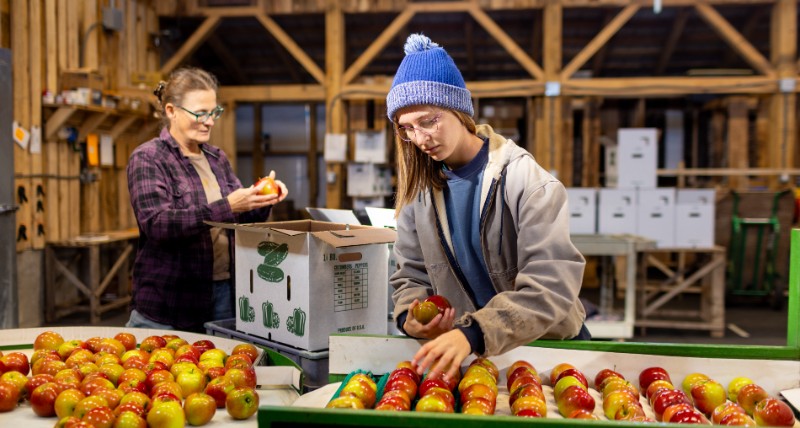
The process of growing apples looks pretty similar across orchards. Trees are set up in blocks, either free-standing or on a trellis. There is a strict spray and management schedule to counter pests and diseases. In late summer and autumn, the apples are hand harvested.
There is much more variability when it comes to the post-harvest handling of apples. I have had the opportunity to both work at an orchard as well as visit orchards, and I’m always as intrigued by what’s inside the pack shed as the apple trees themselves. This is partly due to my previous work in food safety auditing and consulting. I usually worked with smaller-scale growers, whose pack sheds ranged from old barns to open air set ups. Occasionally, there would be a brand-new building with the ideal layout. Now, as I expand my orchardist skills, I wanted to take a deeper dive into understanding what works best for the post-harvest handling aspect for successful apple operations.
Cold storage first
The first step in putting a pack shed together is figuring out cold storage. Chris McGuire of Blue Roof Orchard in Belmont, WI, said, “As far as design of the packing shed, we knew we needed a large walk-in cooler to start with and that was determined by calculating how many apples we were going to grow and how long they were going to stay in there and how many we would have at one time.”
Chris, who also coordinates the Organic Fruit Growers Association (OFGA), and his wife Juli began their farming careers growing vegetables in a CSA model prior to switching to exclusively growing apples in 2018. That move came with the need to tweak their pack shed for handling the crop efficiently. They built a new pack shed and spent a great deal of time and consideration setting it up for success.
When growing vegetables, they had multiple coolers set at different temperatures. Now, with a single crop (albeit of many varieties – they grow more than 20 kinds of apples) and one temperature requirement, it was difficult to manage multiple coolers. Chris says that when they opted for a new cooler, they “made sure it was sized to have an alley to walk in and see everything in there and pull it out based on what we need.” The larger cooler is also more energy efficient.
Working with existing infrastructure
Rachel Henderson of Mary Dirty Face Farm in Menomonie, WI, shared a similar sentiment of planning cold storage first. Rachel and her husband Anton worked with existing infrastructure before designing a new pack shed on the farm. “We started with an all-purpose building which was a barn on the property and had some advantages in that it had a concrete floor and was big enough to build an insulated room inside for our first pack shed,” she says.
At that time, Mary Dirty Face Farm was using a CoolBot – a technology that turns a standard window air conditioner into efficient cold storage and is more cost effective than a walk-in cooler with a compressor. The CoolBot and air conditioner were set up in a 10-12- feet insulated room they built. This amount of cold storage sufficed for about six years before they needed more storage space and more consistent cooling. Some apple varieties are stored for months at a time to sell later in Fall and Winter, while others are chilling sensitive and need a slightly warmer storage temperature.
In planning their new pack shed, Rachel and Anton went with a larger walk-in cooler with a compressor. Rachel notes that having a refrigerator in the pack shed is key. Mary Dirty Face Farm grows berries, which come before the apples and don’t take up the space that apples do. Having a refrigerator for the smaller crops means they do not have to turn on the walk-in cooler until it is necessary, saving a lot of energy and money.
The value of floor space
Outside of cold storage needs, both farms also aimed to understand their respective pack sheds’ floor space and what activities and objects would need to fit there. It can be easy to overlook floor space if you’re focused on equipment. However, when it’s time to grade and pack fruit, you’ll need space for washing containers and storage for boxes, which may take up more space than you anticipate.
Chris and Rachel highlighted the importance of open space in the pack shed for these various tasks. Mary Dirty Face Farm uses a modular system for their diverse farm. “Having modifiable table space has been huge because we start in the summer with the berries, and we’re often putting those in clamshell or pulp containers. Then we move into tree fruit with plums that are messy and then apples. We ended up with multiple table sizes that make modifying the space much easier.”
At Blue Roof Orchard their floor space changes, too, depending on if they are washing/grading apples or if they are packing for their apple CSA. This efficient use of space helps with flow and efficiency. This was a good reminder for me that it’s important to leave space and grow into it or take the time to foresee those efficiencies, especially as a new farmer.
Space for harvest containers, packaging materials and other supplies was factored into the design as well. Both farmers said that having enough space means buying more items in bulk, getting a better price, and saving on shipping costs. At Blue Roof Orchard, one side of the pack shed is dedicated for harvest and post-harvest containers, while the other side is dedicated for reuseable CSA boxes.
Food safety and water
Managing space is also important for food safety and product quality concerns, as is water placement and usage. An apple pack shed uses water much differently than a vegetable pack shed. The latter requires more water and, therefore, a different design.
Chris knew this when designing his apple pack shed. He purchased a new brush washer to account for pushing more apples through at a time. He also intentionally located a floor drain underneath where they wash out harvest and post-harvest containers. Keeping the water in one location in a pack shed is ideal. Not only will your footwear stay dry(er), but it will help to limit potential cross contamination issues.
Equipment for post-harvest handling varies significantly across orchards. As noted above, Chris uses a brush washer that was purchased last year through a Resilient Food Systems Infrastructure (RFSI) grant. Before that they used a smaller one they had from their vegetable production days.
The new washer lets them move more apples through; even though they are a relatively smaller orchard, it has greatly improved efficiency. As Chris says, “If we are in here, we would like to get the washing and grading done relatively quickly and move on to more enjoyable things!”
Post-harvest handling
Other orchards choose to hand grade apples from one container to another. I have done this work by pulling a stack of ungraded apple boxes in front of me, putting on a podcast or pump-up music depending on my energy level, and grading into boxes for large #1 apples, small #1 apples, minus grade apples for baking/processing, minus grade for cider apples, and finally a 5 gallon bucket for apples for the sheep.
At the orchard where I work, we use wooden apple boxes that have been in operation for decades. They have done the trick for years while this multigenerational orchard has hummed along. Obviously, there are other options available today, but these still work just fine.
At Blue Roof Orchard, Chris has some harvest and post-harvest containers that are carried over from vegetable days. He’s developed a system that works well for moving them around, which is admittedly easier with plastic than with wood. Crates that nest into each other or stack, depending on how you place them, are put onto a small plastic pallet and moved with a dolly[JN1.1]. Collapsable totes are also useful for grading and packing. They are easy to move and can ultimately go on a cart and into the cooler. This helps not only with efficiency but can save one’s back!
Whether you are starting an apple operation from scratch, transitioning from vegetables, or looking to improve your operation, you’ll thank yourself later if you do some planning now.
Consider how the space will be used, how many people will work in it at once, and what tasks and movements they will need to make. Think through the workflow from start to finish. What types of coolers do you have, or what would you like to add? If your operation grows, what will you need next, and where will it go? Are water, electricity, and other utilities located in the most convenient places?
With this in mind, I encourage you to put on your headphones, listen to some music, and start sketching your dream pack shed!