

Building A Tool Library: Advice from Sam Oschwald Tilton
By Q & A with Sam Oschwald Tilton, Glacial Drift Enterprises
Publication
Summer 2026
Ri venest eveniendit as quisit fugit quiam, te pore por aceaque es seris re quistotatet qui.
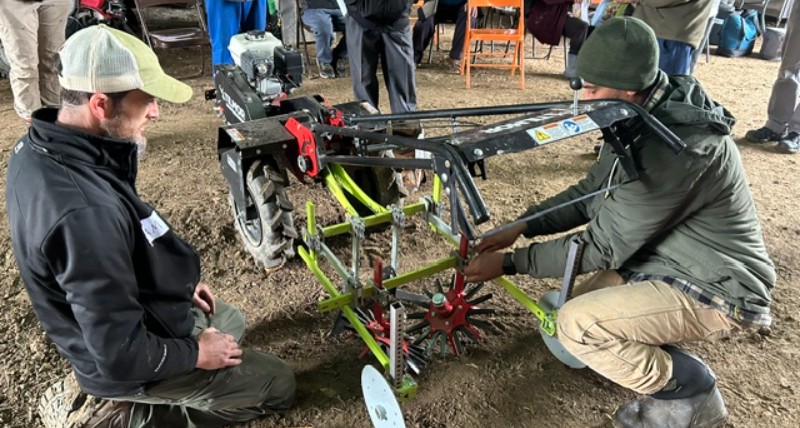
Two thousand dollars. That’s how much farmer Vang Lee figures he has saved by belonging to a tool library. He is part of a group of farmers, many of whom are Hmong Americans, who farm at Fondy Farm north of Milwaukee. Last year, the Fondy Food Center, which oversees the farm as part of its work to provide local, healthy, and culturally relevant good the greater Milwaukee area, started the tool library to help farmers access more equipment and expand their farming capacities.
They worked with Sam Oschwald Tilton, who was then working for University of Wisconsin Extension, to create the tool library. Sam now has his own business Glacial Drift Enterprises. We spoke with him to learn more about how any organization or group of farmers might go about starting a tool and equipment sharing system.
Getting Started with Tool Libraries
Marbleseed (MS): How did you get involved with tool libraries? In other words, what are your bona fides on this topic?
Sam Oschwald Tilton (SOT): I’ve been involved in sustainable and organic agriculture for 15 years. I worked on a CSA farm during the time it was being started from scratch, and we borrowed a lot of tools, including from the farmer who mentored us. As a graduate student at Michigan State University, the professor I worked with was focused on weeding tools, which continues to be one of my areas of expertise. We’d take tools to an event and ask farmers to borrow them, use them, and report back to us in a month with feedback and data. I’ve continued this kind of relationship to tool sharing as a way of learning through my work at the University of Wisconsin Extension and now as a consultant.
Tool Library Models
MS: What kinds of organizations typically start and run tool libraries? What examples have you seen?
SOT: When I was writing the grant with Fondy Farm, I found as many tool libraries as I could to use as models. I don’t think I found any that are organized by a group of farmers. Instead, most are run by nonprofits, partly because they have the capacity to go after grants. I also found a few that are run through community colleges or conservation districts.
Some are based around just one or two large tools, like a no-till drill that a conservation district purchases to address a resource issue they’ve identified, or something outside of most farmers’ budgets, like a tractor-pull flamethrower.
Some tools lend themselves more toward sharing. People tend to need weeding tools all at the same time, so they’re less effective for sharing. But it’s great to have different weeding tools available for farmers to try for a short period, and then they can find what’s right for them and purchase it. This helps prevent buying a tool that you’ll end up never using because it wasn’t a good fit. So much depends on your soil, the crop, even the personality of the person using it.
MS: Have you seen tool libraries more often in other parts of the world?
SOT: Definitely in poorer countries, farmers are more accustomed to sharing equipment. I’ve seen a lot of this during visits to Vietnam, Guatemala, and Jamacia. Oftentimes, farms are smaller and closer together, which helps. In Europe, governments provide much more money to farmers to purchase machinery, so the farms I visit there usually have newer and better machinery as compared to the U.S.
Approaches to Funding
MS: What do you suggest in terms of funding a tool library?
SOT: Nonprofits tend to either fund it from their operating budgets or write a grant. When I wrote the grant for Fondy, I was able to reach out to companies that I have relationships with and ask for a discount to stretch the grant. I always want to add value to the company when I do this, so I suggest being explicit about what they’ll receive in return. They could be listed on an info sheet that accompanies the equipment, or you can offer for them to give a workshop or presentation.
MS: What are the very first things you recommend doing if a group is considering starting a tool or equipment sharing system?
SOT: The very first question is: Who is your audience? What are their needs? What is their access to transportation? You might purchase a big no-till drill – which is cool – but if you don’t have access to a vehicle to pull it, then it’s going to sit around and go unused.
Develop a brain trust of people who will develop and fine tune a vision. Once you have the vision solidified, you can write a grant or figure out funding. This should include the initial amount needed to procure a starting collection, as well as money for storage, maintenance, and paying someone to oversee the lending system.
Figure out how it’s going to work on a day-to-day basis. Will people need to be trained on the equipment to check it out? Holding workshops and training days is a good way to make sure people know how it works and can ask questions. These events also build community.
Setting Clear Expectations
Be realistic when you’re setting things up. We tend to be very idealistic in the organic farming community. The reality is that people won’t bring things back. It’s not necessarily a bad intention – just people get busy, they forget. You really need a point person who will manage the library. Make sure it’s clear whose job this is and allot time for checking items in, doing maintenance, and educating people. Don’t underestimate how important this role is to the library’s success.
MS: What system works best for tracking tools?
SOT: On one hand, it would be way easier if it was all online. But it comes back to your audience.
What’s best for them – not for you as an administrator. At Fondy, most of the audience are Hmong and/or are older. They don’t speak English or their digital skills are limited. So Stephen Petro, the director of farming operations, uses a clipboard checkout system – pen and paper.
MS: Do people pay to be part of a library? After all, most of us are familiar with public libraries that operate without any cost to the user.
SOT: Most tool libraries I’ve seen have some membership payment. I don’t think people value things as much when they’re free; people take better care of things when they have skin in the game. Also, consider what happens when you need a new air filter or a tool gives out. There needs to be some income to support purchases.
MS: Is it necessary to have insurance?
SOT: The organization that oversees the library either needs to amend its insurance or have clear language about liability. Having a clearly stated policy that the organization is not liable for any damage or harm – preferably language developed with assistance from a legal expert – is the easier way to go. I also recommend having anyone who wants to rent equipment be required to take a class that includes safety. Document their attendance as part of the liability paperwork.
MS: Let’s return to that brain trust you suggested. Who is part of that?
SOT: We all know that most farmers don’t have time. There are maybe 5% of farmers who actually call you back when they say they will – me included! Diamonds in the rough, let’s call them. Find one of these as a representative from the farmer community. And if you can’t find them, then you take the temperature during a winter conference – ask about what kinds of tools people need.
Then think of anyone with the 10,000-foot view of your audience. They’re not in the field every day, but they understand the bigger picture. It might be someone from extension, or a seed company rep. They understand the farmer mindset and will help keep the project realistic.
Obviously, there needs to be someone involved from the organization that’s backing the project. It’s great to have someone who knows machinery. And then a person who is fantastic at writing grants is invaluable.
MS: How many people do you recommend inviting into the library as users?
SOT: Don’t be too nice and say everyone can be involved right away. Start with a small group of farmers who either showed up during the planning or are already connected to the organization. You want people who are dedicated. It can expand but start small. Learn what works and what doesn’t as you develop a system. I also recommend starting with farmers who have some experience. Beginning farmers are more apt to break things just out of lack of experience.
MS: What happens when something breaks?
SOT: When the library manager checks tools in, they need to look for damage or any problems. People won’t always tell you if something went wrong. I also recommend investing in really robust tools or modifying them so they’re less likely to have something go wrong. For example, I have two-wheel tractors with the engine mounted on the front, and it’s very easy to damage, so I’m building guards that go around the engine.
MS: Are there any final pieces of advice you’d give?
SOT: Yes – storage! I’m passionate about protecting tools. Everything needs to be under cover, and it can’t just be a tarp. It also needs to be accessible. Will there be specific hours when the library is open, or will members have access 24/7? If the organization behind the library doesn’t have a physical space to house it, consider renting part of a farmer’s machine shed.
RESOURCES
Following are examples of several farm-related tool libraries and related resources. We’ve highlighted exemplary aspects of their work, though there are a lot of ideas to inspire anyone who is considering starting a sharing system.
• The Underwood Conservation District in Washington state has a large amount of information available via PDF on its site, as well as agreement documents and videos that show how to use larger pieces of equipment. https://www.ucdwa.org/farm-tool-library
• The Farm Connect Tool Library in Montana is an example of a library that is built around a few larger and most costly pieces of equipment. https://farmconnectmontana.org/farmer-support/farmer-tool-library
• The KC Farm School has multiple lending libraries, including books, seeds, and event equipment. We appreciate the clear language of its lending agreement. https://www.kcfarmschool.org/lending-libraries
• Clarity must be in the water in Kansas City because another urban ag organization in that city, Cultivate KC, also has excellent Terms and Conditions language, as well as great organization by kinds of tools.
• The Farmers Toolshed in eastern Iowa has a unique owner member LLC business model. Purchase of a $500 ownership share or transfer of ownership of a piece of equipment for that value or more gets one membership. https://farmerstoolshed.org/
• LendEngine provides free or low-cost software for tool sharing.
• Shareable offers a comprehensive guide to starting and growing all kinds of sharing libraries. It includes many of the topics covered above, as well as communications and marketing, environmental impact tracking, and a bevy of videos and templates.