

Planting in Unpredictable Times Too wet, too cold – what else is new?
By Dave Campbell, Lily Lake Organic Farm
Publication
Summer 2026
Ri venest eveniendit as quisit fugit quiam, te pore por aceaque es seris re quistotatet qui.
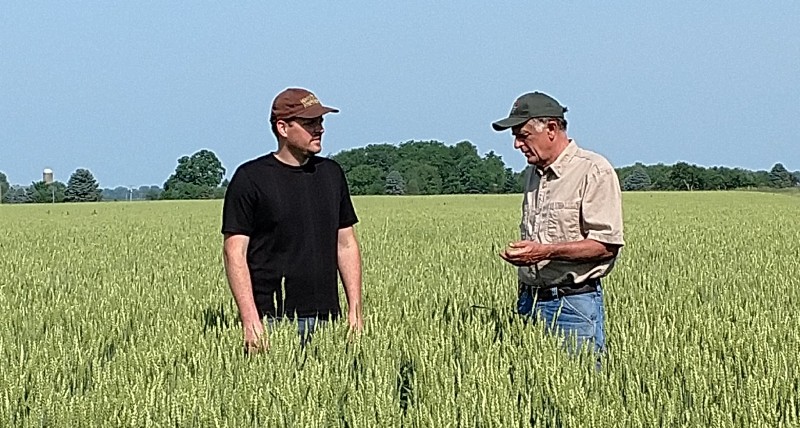
This spring saw another undesirable weather pattern in the Upper Midwest. March had some well above normal temperature days. April was also mild, although will be remembered more so as very wet. Rainfall totals for April in my area near DeKalb, IL, ended up in the seven to nine inches range – more than double the monthly precipitation average.
Then came May, pretty much a complete reversal of April, with very little rain, much cooler temperatures, and many frosty mornings. I am writing this on Memorial Day, and we’ve only had one rainfall event this month that totaled more than .2”.
Weather variability has always been a constant here in the Midwest. While technological advances in weather forecasting are certainly welcome, we are still at the mercy of whatever the rain gauge reveals. Spring of 2026 presented a decision-making scenario in many areas of the Great Lakes region that involved the decision of whether to sow a small grain crop versus forgoing small grains in place of planting corn or soybeans.
Thoughtful soil disturbance
The Upper Midwest is dominated by heavier deep silt loam and silt clay loam soils. I try to hold off as much as possible on tilling soil earlier in spring when the ground is cold and still somewhat wet. The exception, of course, would be tilling the previous year’s soybean ground in front of an early spring small grain crop, since typically only shallow and minimal tillage would be needed.
One of my favorite quotes comes from Gary Zimmer, who I first met in our dairy barn in 1986: “What is tillage? THOUGHTFUL disturbance of the soil.” To that end, I usually find that it’s better to wait rather than to proceed with tillage when the soil is unfit to work. One option may be to flail mow weeds when the ground is a bit too wet to till. My preference has always been to “lift” the soil versus “packing” the soil, much more so in the spring, which for me means using a field cultivator rather than a tandem disk or a high-speed disk for spring tillage.
When addressing weed seed predation issues – a natural ecosystem service where predators consume or destroy weed seeds before they can germinate – you may want to take a pass on fall tillage. Consider whether or not to chisel plow or deep rip a cornfield after fall harvest, especially if the weed pressure was not to your liking. I suggest letting the mice and birds harvest those weed seeds for you, given the weed seeds will be on top of the ground if no fall tillage is done. Mice will eat weed seeds under a snowpack, and you’d be surprised at how many weed seeds a single mouse or even a cricket can consume in just one day!
As organic grain farmers we need to hold off on planting row crops, such as corn and soybeans, when compared to planting dates of our conventional row crop neighbors. That said, we should remember that spring planted small grain crops, such as oats, barley, wheat, triticale, etc., should be sown as soon as possible, assuming field conditions and weather forecasts are favorable, or at least not detrimental.
How early is too eary?
How early is too early for these spring planted grains? Should we plant if there is a warm and dry spell in late February or March making field conditions fit to sow? This past February, Dr. Margaret Smith, an agronomist with Albert Lea Seed, gave an in-depth presentation on this topic. Sowing these spring planted crops too early, she said, can result in poor germination and uneven stands.
Fall sown winter wheat should be sown as soon as possible after the “Hessian fly-free date.” (Check with your crop insurance agent on planting cut-off dates for your location.) Sowing winter small grain crops is very much a timing issue. Should you decide to sow winter rye, you will have a much later planting window, given the hardiness of winter cereal rye. Winter rye can usually be sown until Thanksgiving in the Illinois/Wisconsin state line area. There is one major exception and that would be when sowing rye for the purpose of roller-crimping that rye stand the following spring prior to soybean planting. Dr Erin Silva, a specialist in organic and sustainable cropping systems with the University of Wisconsin, has presented some well-tested research showing that earlier planted cereal rye greatly increases the success of weed control in soybeans the following year.
In my region of Illinois, there are thousands of acres sown to oats each year. Unfortunately, this spring most of the oats that were sown were not planted until the last couple of days of April and the first week of May before field conditions were suitable.
Lessons from 1993
More seasoned farmers may remember the Great Flood of 1993 that impacted the Mississippi and Missouri river basins along with their tributaries. My oats sowing date that year was the first week of May. At harvest time, oats were tall, had a nice color, and looked great. But looks can be deceiving.
The test weight on oats on my farm that year ended up at 27 pounds per bushel which meant no Food-Grade Market that year given Food-Grade oats need to be in the 38 pound test weight range. It goes without saying that a very low test weight will result in a low yield.
Normally, winter wheat will head out two to three weeks before oats. This year’s conditions have brought on earlier winter wheat maturation. Driving around in late spring, I noticed winter wheat that was headed out, while in a nearby field oats were only about ankle high.
Crop rotation and certification
Maybe you were one of those farmers who decided to make a change in your crop rotation this spring given your inability or preference to forgo sowing a small grain crop, given very wet soil conditions. USDA-NOP allows for a change in crop rotation for circumstances like extended wet weather, so long as the new rotation complies with the organic crop rotation standard.
As always, check with your certifier sooner rather than later before making any adjustments to your planting intentions. Certification agencies may differ in what practices are allowed when delayed planting scenarios present themselves. A core principle requires that a certified USDA organic crop rotation must avoid so-called monocropping. In organic production monocropping implies the planting of row crops year after year without a small grain crop or perennial crop like hay being grown within the rotation cycle.
A common grain rotation in the Upper Midwest consists of sowing a small crop like oats followed by corn and soybeans over a three-year cycle. The oats crop can be underseeded with a cover crop of red clover or a multispecies cover crop mix can be sown after the small grain crop is harvested in mid-to-late summer.
While it is difficult to accept the financial results of an oats crop that yields poorly due to very late planting, keep in mind that switching acres over to a row crop will require some long-term sacrifices. Even if your certifier allows you to plant all or most of your intended spring small grain crop acres to corn and soybeans, you need to consider whether you have enough storage to hold those extra row crop bushels of grain, or sufficient labor at harvest time. Also keep in mind that your rotation will be “off” for next year and probably for another year or two beyond. My point is that sometimes you just need to bite the bullet this crop year so that you won’t need to deal with rotation issues in following years.
Options and challenges
You’re reading this long after your crop rotation decisions for this year have been made. But this won’t be the first spring with challenging weather and hard decisions to ponder. In the future, rather than resorting to corn or soybeans, consider a new crop such as buckwheat. Buckwheat is typically sown in late June further north but can be sown as late as July or early August further south as a cash crop and later as a cover crop for soil health purposes.
Along with the weather, another disappointment in farming news this spring and early summer has been fertilizer prices – namely for synthetic fertilizer. Poultry and turkey manure (litter) is the most frequently used fertility product for Midwestern organic grain farmers. For now, litter prices have not increased too much across the Midwest. That will change if the situation in the Middle East doesn’t get resolved soon. And we’ll have competition; conventional grain producers are already booking allotments of litter for this fall. Bird flu has already contributed to price changes. The culling of flocks has led to a decrease in available litter; we saw a 20% price increase in litter in my area last year.
Naturally mined products like gypsum, soft rock phosphate, and sulfate of potash, (0-0-50), have seen only modest price increases. However, the soaring price of diesel fuel is impacting all off-farm fertilizer purchases. There will most likely be a price increase of soil amendment products this year.
The variables of weather, world events, bird flu, and other factors are making our already challenging decision-making more complicated. Whether you’re currently trying to right your course after decisions you made during the wet spring, or you’re looking ahead to next year as fuel costs fluctuate, know that there are always adjustments you can make. Changing crops, playing the waiting game, and switching inputs are all options you have control over.