

Equipping an Ice Cream Operation: How a 5th Generation Dairy is Expanding
By Marbleseed
Publication
Summer 2026
Q&A with DIxie Klemish, Klemish Farm & Creamery
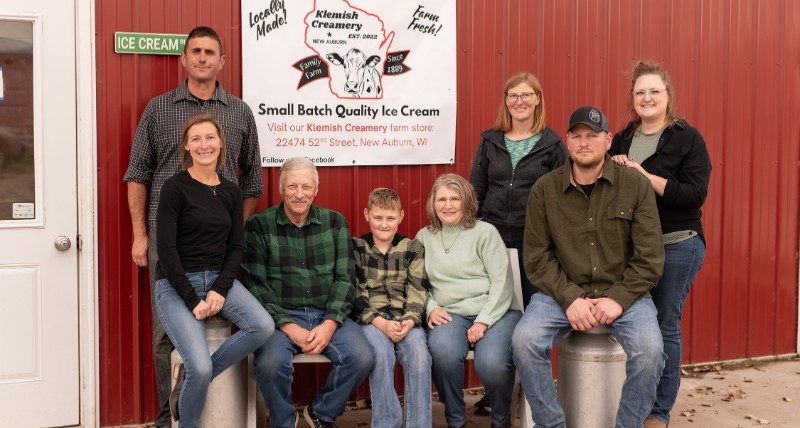
We all scream for Value-added Dairy products!
Klemish Farm in New Auburn, WI, has been family-owned since 1889. It’s now run by the fourth and fifth generations – Randy and Dixie Klemish and their son and daughter-in-law, Joe and Trista Klemish. They are forging a new path for their operation, adding ice cream and cheese, along with the milk they continue to sell to a local cooperative.
During the Covid-19 pandemic, milk joined flour and toilet paper as a staple item that disappeared from grocery shelves. Simultaneously, largescale purchasers, such as school districts, canceled orders. Many dairies were forced to dump their milk and reduce production. Six years later, production rates are still reduced.
It was this reality that led the Klemish family to invest in facilities and equipment to add ice cream production to their business. Dixie Klemish says the family had considered value-added products before, but it was the forced 7% decrease in production during the pandemic that led them to get serious about what that would involve.
Unlike many neighbors, they didn’t dump their milk but pasteurized it and began making ice cream on a very small-scale for friends and family. But what would it look like to scale up and sell to the public?
We talked with Dixie about this “leap of faith,” the additions they’ve made to their farm, which now includes Klemish Creamery and plans for the future.
A leap of faith
Marbleseed (MS): Tell us how you began with adding ice cream to your business? What was involved in terms of infrastructure?
Dixie Klemish (DK): Building and opening Klemish Creamery seemed like a leap of faith in the beginning. When the whole goal of the new venture was to help keep more profit on our small farm, it felt contradictory to spend money on infrastructure. With the help of family and neighbors, we spent the winter of 2021 and the following spring constructing interior walls. It was hard to know how much money to invest with limited information on how much customer demand there would be for the product.
MS: What funding sources have you accessed to help with building and equipment costs?
DK: We’ve received two grants from the Dairy Business Innovation Alliance (DBIA). The first helped with the initial construction and equipment. In 2024, we got a second DBIA grant, to help purchase a cream separator and a larger pasteurizer/ cheese vat, which allows us to utilize more of our milk for ice cream. That same year, we received a Resilient Food Systems Infrastructure Grant (RFSI) to collaborate with small farmers and processors to distribute value-added farm products in Northwest Wisconsin.
MS: What has been the learning curve in ice cream making?
DK: We are such a small-scale artisan operation that it hasn’t been too bad. It took some trial and error to develop our base ice cream formulas, but we’ve found helpful websites and social media groups of homemade ice cream makers who are generous with sharing information. We also visited other dairy plants on farms producing small, value-added products. Getting their advice was very helpful, and we now give tours and provide advice to farmers considering processing dairy products on their farms.
Navigating challenges
MS: What regulations were involved in scaling from homemade ice cream to selling to the public?
DK: It’s overwhelming – the FDA’s Grade “A” Pasteurized Milk Ordinance is over 400 pages! Thankfully, the Wisconsin code is only around 75 pages. We got help from a retired state dairy inspector to meet the FDA Pasteurized Milk Ordinance (PMO) and Wisconsin DATCP regulations. Our dairy plant was officially inspected and licensed in August 2022, and we opened for business in November 2022 – not the most ideal month for ice cream, but it was good to have time to get up to speed before the warmer months.
Some of the biggest challenges have been finding small-scale equipment that meets the 3A standards required for dairy processing in Wisconsin [see side bar] and finding equipment that runs on single phase electric. Much of the available USA-made small-scale dairy processing equipment is larger than what we need. It takes up too much space and is designed for a larger capacity. The cream separator is a good example. The one we purchased, which was manufactured in Italy, is still larger than what an operation of our size would require, but it is the smallest 3A certified separator we could find.
Our son Joe also got a bulk milk weigher and sampler license. We received a waiver to allow us to move milk to our creamery in modified stainless steel milk cans via a small wagon to do this. Despite this very small-scale operation of moving milk, Joe needed the same license that someone driving a large milk truck needs so that he can legally sample and test the milk quality.
MS: What is single phase electric, for those not up to speed on electrical language!
DK: Don’t worry, I’m still very much learning this stuff! Single-phase power provides a single alternating current (AC) wave, while three-phase power simultaneously delivers three overlapping AC waves, providing a constant, uninterrupted flow of electricity. While the latter is widely used in industrial settings to run heavy machinery and large motors, single phase is what is typically available for rural homes and farms. The infrastructure for three-phase power is not cost effective with the vast distances covered in rural areas. I would call the size of our operation a micro-dairy processing plant.
MS: Tell us about the role of the cream separator. Where did you get yours and what are the costs?
DK: The second DBIA grant allowed us to purchase a separator. This equipment allows you to isolate the rich cream and control the exact fat-to-milk ratio. Ice cream really needs to have the milkfat percentage dialed in; fat content in milk changes with time of year and what the cows are eating. Since we strive for a minimum of 15% butterfat in our high-quality ice cream, there was no way in the beginning to make ice cream without relying on store-bought heavy cream to add to our milk.
With this equipment, we can now use more milk from our dairy herd as it takes four times the quantity of milk to get the amount of butterfat needed for our ice cream formula. However, that leaves us with skim milk left over, which is the reason we are working to expand into cheesemaking, especially lower fat cheese products.
We can also eliminate some of the additives from our ice cream that came in the purchased cream. We’re especially excited to be able to eliminate the carrageenan added to most heavy cream, allowing us to make ice cream with a more consumer desirable clean label.
MS: A homogenizer is another piece of equipment we know some producers invest in. Do you have one?
DK: No, we don’t have a homogenizer. We like that the fat globules in our milk remain closer to their natural state instead of being broken down during homogenization. This does cause some challenges in ice cream making; there’s an increased tendency to create butter balls while churning and freezing the ice cream with non-homogenized milk, but we’ve been able to develop a formula and process for making our base ice cream mixes to prevent that.
MS: What other equipment have you purchased and how did you learn about it?
DK: We spent a lot of time on the internet researching equipment, reading blogs, articles, and websites about other operations. For instance, hand wash sinks that can be operated hands free are a requirement. New sinks with hands free features are expensive. Used hand wash sinks on auctions are inexpensive, but the ones I found were not hands free. I found an automatic motion sensing adapter on Amazon for less than $40 that attaches to the faucet making the sink hands free. With three hand wash sinks in our processing areas, this saved us hundreds of dollars.
The RSFI grant allowed us to purchase walk-in cooler and freezer units. I’ll add that navigating purchase decisions with the uncertainty of tariffs has been difficult. Much of the small-scale processing equipment approved for use in Wisconsin is made in foreign countries. We have equipment that was manufactured in Greece, Italy, and the Netherlands.
Collaboration & Growth
MS: The RFSI grant enables collaboration with other small farmers and processors. Can you describe how that network actually works day-to-day? How many farms or producers are involved? Do you imagine collaboration with infrastructure in the future?
DK: This project is in the very beginning stages. We are collaborating with small farmers and processors in Northwest Wisconsin to distribute value-added farm products. Our goal is to build up to a collaboration with 15 farmers. This collaborative distribution plan will benefit small enterprises, especially those who lack frozen and refrigerated delivery methods for their products.
We have the delivery vehicle and freezer and cooler space installed. Now we need to focus on the rest of it, which includes seeking more farmers who could benefit from the delivery and product cooling resources we now have available. The Glass Orchard in Eau Claire, WI is one processor we are working with. We use their cider in our caramel apple crisp ice cream each fall. We sold their cider in our store last year, and they plan to sell our ice cream at their orchard this year. We’ll also be setting up an ordering system for retailers and delivery routes schedules.
MS: Now that you’re a few years in, what have you discovered about scaling this business?
DK: In terms of space, we could definitely use more. When we built the facility, it was so hard to estimate what our growth might be and we only had so much money, so we opted to go small. We quickly filled the space. We’ve been able to make space to fit the required cheesemaking equipment but will likely need at least a small addition for more storage in the near future.
We currently have five part-time employees. Our ice cream is made in small batches and is labor intensive, especially given that we make many of the additional ingredients like sauces and cookies that go in it. This limits the amount of ice cream we can make relying solely on immediate family labor. Our growth – mainly word-of-mouth advertising from loyal customers and increased retail locations – forces decisions about hiring more people and time management between all the normal work of a dairy farm and the added work in the creamery.
MS: Where are you with starting cheese sales?
DK: I am nearing the end of the process of becoming a cheesemaker, which includes 240 apprenticeship hours and five cheesemaking and dairy processing education courses. I did my apprenticeship hours with Rama Hoffpauir at Cosmic Wheel Creamery in Clear Lake, WI.
We could have made cheese with the equipment we already had, but we purchased a larger combination pasteurizer/cheese vat. It has a bottom drain for removing whey that our smaller 30-gallon pasteurizer did not. I will need smaller equipment such as cheese molds and a draining table for sure. A cheese press, curd mill, and cheese aging cabinet or room are future purchases depending on the types of cheese we make.
MS: What advice do you have for any farm considering adding ice cream to its farm offerings?
DK: We are glad that we chose ice cream as our first product to make in our dairy processing plant.
Ice cream seems to make people happy, and it’s brought many people to our farm. It’s gratifying to see them enjoy a glimpse of farm life and the beautiful scenery we are surrounded by.
It does change life on the farm though. My advice for anyone wanting to begin making value-added dairy products, whether ice cream or another dairy product, would be to think carefully about what you are willing to change about your farm and your life. If you don't want visitors to your farm daily, where will you sell your product? If you are already struggling to find enough hours in a day for basic farm tasks, adding dairy processing to the workload is an additional burden.
I was a full-time mail carrier when we opened the creamery. The family pitched in and we managed our first few years, although my husband Randy ended up making more ice cream than we anticipated in the beginning. I’m now retired from my job and have more hours to dedicate to Klemish Creamery and am looking forward to more new ice cream flavors and dairy products to offer in the future!