
By Dylan Bruce, Driftless Seed Supply
Publication
Winter 2026
Seed is quite literally foundational to our food system. Yet it is often overlooked in grant programs, policies, and discussions about local food systems, by consumers and farmers alike.
Despite steady growth in organic acreage and consumer demand, the percentage of organic seed used on certified organic farms has remained largely unchanged over the past two decades. The 2022 State of Organic Seed Report (an ongoing project of the Organic Seed Alliance updated every five years) makes this tension clear: Organic farmers overwhelmingly support the idea of organic seed, but structural barriers like availability, scale, price, and varietal fit, continue to limit adoption. As a result, exemptions that allow untreated conventional seed have become routine rather than transitional.
This gap is not simply a supply problem. It reflects how seed has been positioned in modern agriculture, as a standardized commodity rather than a living foundation of agroecological systems. Addressing it requires more than increasing production. It requires re-imagining how seed is grown, governed, and shared.
Across North America, farmers are already doing this work. Regional seed companies, cooperatives, and grower networks are building farmer-centered seed economies grounded in shared knowledge, regional adaptation, and collective responsibility to seed diversity.
Organic seed and the limits of the current system
Under USDA organic regulations, certified farms must use organic seed when it is commercially available. In practice, this requirement is softened by exemptions that allow conventional untreated seed when organic options are limited in quantity, quality, or form. While these exemptions were designed as a bridge, they have become a feature of the system.
The State of Organic Seed report notes that this dynamic discourages investment in organic seed production and breeding. Seed companies receive weak demand signals, while farmers remain reliant on varieties bred primarily for high-input or conventional systems. The result is a self-reinforcing loop: limited organic seed supply justifies continued exemptions, and exemptions dampen market pressure to expand supply. Additionally, the proportion of respondents who report pressure from certifiers to use more organic seed has declined over the years.
Organic seed is not simply a regulatory checkbox. Seed grown under organic management experiences the same nutrient limitations, weed pressure, and biological interactions as organic crops in the field. Over time, this creates opportunities for selection that can improve performance in low-input systems - particularly when seed is produced repeatedly in the same region.
Logically, why would a bell pepper bred for conventional production in California or Florida be the best possible option for organic farms in the Midwest?
Regional adaptation as agroecological practice
One of the clearest benefits of regional organic seed systems is adaptation. Climate variability, erratic rainfall, and new pest and disease pressures are already testing farm resilience. Seed that has been selected under local and organic conditions, rather than bred for broad, uniform environments, can respond more effectively to these challenges. When grown in the region it is intended to be marketed to, it can continue to adapt and ‘roll with the punches’ of climate change. Logically, why would a bell pepper bred for conventional production in California or Florida be the best possible option for organic farms in the Midwest?
In their 2024 master’s thesis, Seeding Agroecological Economies, my colleague Elena Bird describes how seed grower cooperatives function as sites of in-situ adaptation, where farmers collectively steward varieties across landscapes rather than relying on centralized breeding pipelines. These systems emphasize learning by doing: shared trials, farmer observation, and iterative selection across seasons and farms.
This kind of regional adaptation and resilience does not require abandoning yield or reliability we have come to expect from our modern seed varieties. It requires shifting where and how those traits are developed. Instead of relying solely on breeding programs geographically distant from farms, regional seed networks integrate farmers directly into the process of improvement. Instead of relying solely on hybrids that can quickly fit uniform consumer expectations, it requires a slower, more intentional process of developing open-pollinated varieties for more niche production environments.
As the late, great organic seed breeder John Navazio once told me, “Anything you can do with a hybrid you can do with an open-pollinated variety, it just might take longer.” (OK, I know there are some exceptions like corn, but he proved his point with staples used on vegetable farms across the country like Astro arugula.)
At Driftless Seed Supply, for example, we focus on varieties that perform well in Midwest conditions: shorter seasons, variable moisture, and lower fertility systems. This approach mirrors and was inspired by cooperatives in the Northern Rockies and Pacific Northwest, each responding to their own ecological realities. The result is not a single “best” variety, but a diversified portfolio of seeds shaped by place.
Seed as an additional farm enterprise
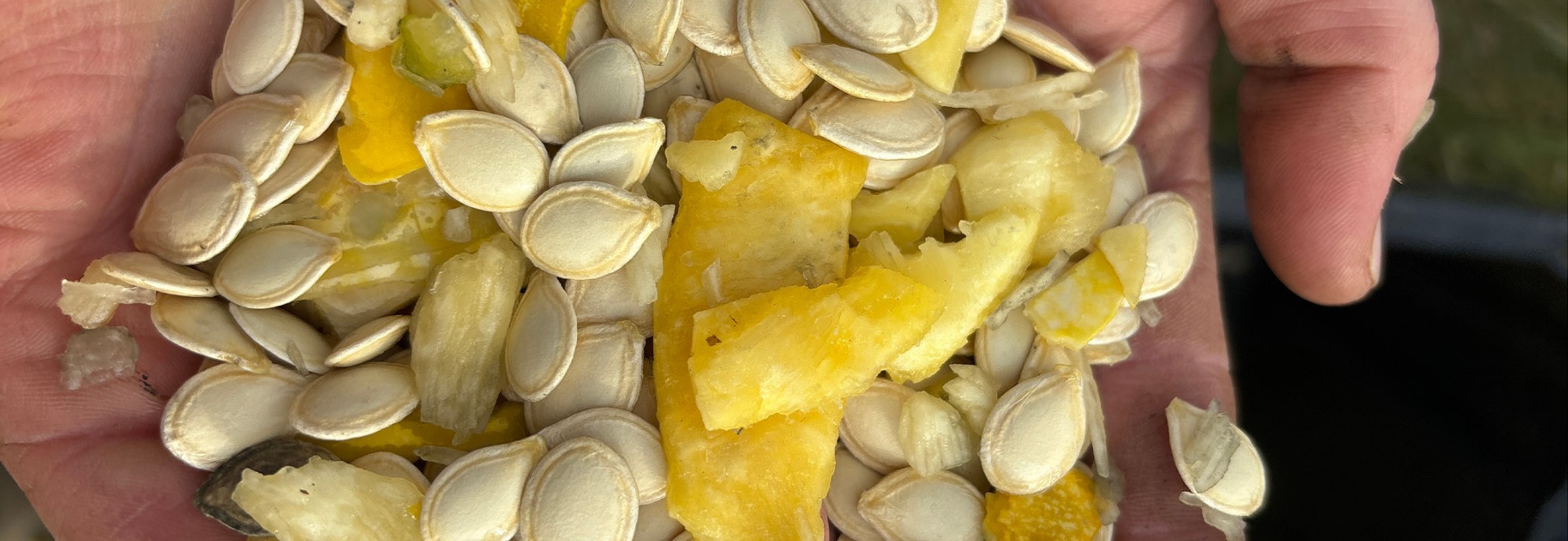
For many diversified vegetable farms, seed production offers a complementary enterprise that aligns with existing skills and values. While seed crops often require longer timelines, isolation planning, and post-harvest handling, they also offer higher value per acre and less vulnerability to short-term market swings. The switch from a CSA farm cadence to seed production was a game changer for my seasonal burnout. For the most part, I now plant and harvest each crop just once, while at the same time having winter work that allows me to support year-round employment!
Bird’s research highlights that many seed growers within cooperatives are also fresh market farmers, and this is certainly true of our grower network for Driftless Seed Supply. Rather than replacing vegetable production, seed growing allows them to layer enterprises, spreading risk while keeping land in food production. Importantly, seed income often arrives at a different point in the year than produce sales, helping smooth cash flow.
Just as importantly, growing seed keeps economic value within organic and regional food systems. Instead of purchasing seed produced overseas or by multinational corporations, farmers circulate dollars among peers, supporting regional infrastructure, and community resiliency. This mirrors the motivations that drive CSA models and farmers markets: keeping food system wealth closer to home.
Collaborative seed companies play a critical role here. By aggregating seed, handling quality control, and managing distribution, they reduce barriers for individual growers. Working together and spreading out seed production also offers resilience to extreme weather events, which can often be very isolated. For instance, in 2023 one of our two home farms for Driftless Seed Supply, in southwest Wisconsin, experienced almost 70% crop loss due to extreme flooding. Yet our other farm, barely an hour away in Minnesota, had less than half the amount of rain, and a fairly normal season (if our weather can ever be described as ‘normal’ these days).
Values and the global seed supply chain
For farmers serving local and regional food markets, seed sourcing should also be a question of mission alignment and values. A little-known fact is that many hybrid cucurbit and solanaceous crops (squash, cucumbers, tomatoes, peppers, etc.) are produced overseas, particularly in China, where skilled hand labor for hybridization is significantly cheaper.
While this system has delivered reliable seed at scale, it often conflicts with the ethics of farms committed to fair labor, transparency, and local economic resilience. The distance between seed production and food production also limits opportunities for regional adaptation and farmer feedback. When there are trade disruptions that interrupt that multinational seed supply chain - such as during the COVID pandemic - there can also be a cascade of impacts on the local food economy.
Bird notes that seed cooperatives are navigating this tension thoughtfully. Rather than rejecting hybrid technology outright, many seek to disentangle breeding methods from proprietary control and opaque labor practices. The goal is not purity, but alignment: ensuring that seed systems reflect the same social and ecological commitments that organic farmers bring to their fields.
Moving beyond the organic seed stalemate
Small vegetable farms (under 50 acres) were the only category of organic farms to see an increase in the proportion of organic seed used in the last decade. The persistent lack of growth in organic seed usage is not due to resistance from small farmers. Rather, stagnation in the industry reflects structural inertia in seed systems built for consolidation rather than collaboration. Breaking this pattern requires coordinated effort and dedication to bringing the farm to table movement full circle, from seed to plate.
Farmers can support change by prioritizing organic seed when it is available, communicating unmet needs to seed suppliers, and exploring seed production as part of diversified farm enterprises. Seed companies and cooperatives can continue investing in regional production, shared education, and transparent governance. Policymakers can refine standards to ensure exemptions remain transitional rather than permanent. Certifiers need to push growers harder on their overuse of loopholes allowing conventional seed.
Seed grower, farmer, and eater collaborations can offer practical pathways forward. As the State of Organic Seed report and agroecological research alike emphasize, organic agriculture cannot fully realize its potential without seed systems that embody its principles.
Seed is not just an input. It is a relationship carried across generations of farmers, plants, and places. As my mentor Heron Breen once said, working with seeds is like time travel, because the seed you hold in your hand is the direct result of countless generations of farmers and seed stewards who domesticated the crop, bred and refined the variety, and maintained it. Then when we plant it, do our own round of selection to adapt it to our region and production methods, and harvest the next generation of seed we have put our fingerprint on that variety, which will in turn be carried into the future and out onto thousands of farms and gardens.
Dylan Bruce, Farmer and Chief Executive Officer for Driftless Seed Supply, grew up on a vegetable farm in Wisconsin’s Driftless region. He has been producing certified organic seed on contract for other companies since 2018, and cofounded Driftless Seed Supply in 2023. Dylan serves as Treasurer of the Marbleseed Board of Directors.
This article is supported through the United States Department of Agriculture (USDA) Transition to Organic Partnership Program (TOPP). TOPP is a program of the USDA Organic Transition Initiative and is administered by the USDA Agricultural Marketing Service (AMS) National Organic Program (NOP).