
By Chris McGuire
Publication
Winter 2026
How can small or mid-sized fruit farms with diverse fruit crops spray effectively, quickly, and economically?
Large fruit farms generally use expensive tractor-powered airblast sprayers to apply their sprays. How can small or mid-sized fruit farms with diverse fruit crops spray effectively, quickly, and economically? Many organic fruit growers spray their trees, vines, and bushes with products such as compost teas, foliar nutrients, and commercial pesticides approved for use in organic production. Some of these organic spray materials are difficult to apply because they settle out of solution readily. For example, kaolin clay will settle at the bottom, and the spray won’t be at full potency. Another challenge is that many fruit crops are trees with large, dense canopies that can be difficult to cover with sprays.
There are multiple options available for smaller organic fruit growers. Here is a summary of the main types of sprayers, including advantages and disadvantages, based on my experience and interviews with growers in the Upper Midwest.
Backpack Sprayers
The simplest sprayers are backpack that hold four to five gallons, have manual or battery-charged pump, and a hand wand with a trigger valve and a single nozzle for application. New hand-powered models cost about $100, while battery powered models cost up to $400. In my experience, battery powered sprayers justify their higher cost if you regularly spray for at least 15 to 30 minutes at a time. Solo has long been a widely available and well-regarded manufacturer of backpack sprayers, both hand and battery powered. Popular power tool manufacturers such as Milwaukee and Dewalt sell battery powered sprayers that use the same batteries as their other tools allow you to reuse existing batteries and chargers. A few backpack wand sprayers with gas engine powered pumps are also available, including the Solo 433 and several Tomahawk brand models.
Advantages: These are the most simple to maintain and use and the most economical of all choices. Several filters need periodic cleaning, while hoses, nozzles, and valves can be replaced at a reasonable price. Wand sprayers allow for precision spraying, which reduces waste, cost, and harm to non-target organisms.
Limitations: There is a lack of any agitation in the spray tank, without which oily (“hydrophobic”) materials separate from the water in the tank and rise to the top, while solids such as kaolin clay can settle out of the water. Deliberately shaking the tank and sloshing the contents around while spraying can provide some agitation. (Some growers, however, report that “shake-n-slosh” dance moves have negatively impacted both their spinal columns and their public image as fruit-growing professionals). With limited pressure and a short spray wand, it’s difficult to spray into the center of a large, dense plant canopy, and it’s nearly impossible to spray the tops of taller trees. The small tank size requires frequent refills. Since it’s common to spray 50 or more gallons per acre in berry plantings, up to 100 gallons per acre in dwarf tree fruit orchards, and higher rates in an orchard of full-sized trees, the small tank is prohibitive.
Variations include a “fogger” or “mister,” which are essentially backpack leaf blowers modified by the addition of a small spray tank and a hose. The Solo 466-Master or Stihl SR200 are examples. A valve opens a slow flow of water from the tank through the hose into the airsteam of the blower. As the water drips into the airstream, it is dispersed into a cloud of tiny droplets that can be aimed into the crop canopy. These sprayers typically do not use a pump; the flow of water from the tank into the airstream occurs via gravity.
Compared to a wand backpack sprayer, a mist sprayer can provide much better coverage in a dense canopy. Mist sprayers require a relatively heavy, bulky gas engine to power the blower. Most backpack sprayers have relatively small tanks that require frequent refills. I’ve found it nearly impossible to direct the mist spray far upward because this disrupts the gravity flow down from the tank. It’s best suited for spraying low berry plants up to five feet high, not taller crops.
Spray While Sitting
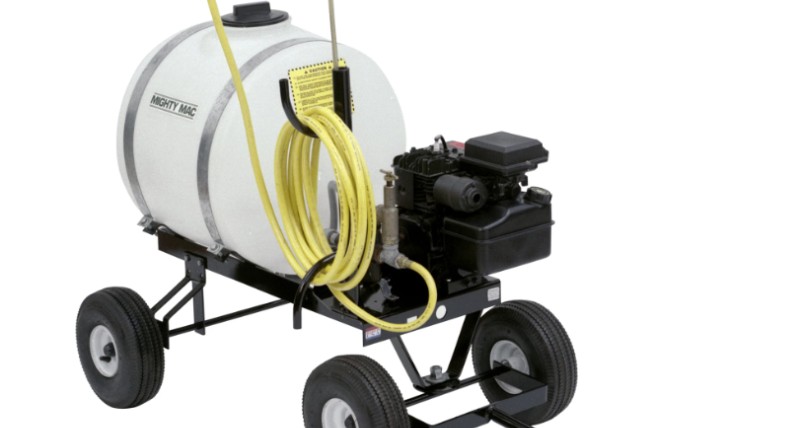
Simple handgun sprayers can be pulled behind an ATV/UTV, riding lawn mower, or tractor. These are basically a spray tank mounted on wheeled chassis with a pump, valves, and hoses ending in a handheld spray gun with a trigger valve. The pumps on these sprayers are powered in a variety of ways: by a gas engine mounted on the sprayer, from the vehicle’s battery, or by a tractor PTO. The size of the spray tanks varies widely, from 20 to 100 gallons or larger. Readily available from many manufacturers and at local farm supply stores, some examples are MacKissic’s Might Mac and various Fimco or Agri-fab tow sprayers. Prices range greatly and can be as much as several thousand dollars.
Advantages: The physical labor of spraying is vastly reduced; there’s no need to walk through the farm carrying 40 lbs. on your back! Because the spray tanks are larger, fewer refills are required. Many fruit plantings of one- to four-acres could be sprayed with just one or two spray tanks. Some (but not all) of these sprayers have “hydraulic agitation” that provides constant churning and helps solutions stay mixed. This agitation isn’t \ perfect, and many growers still take extra precautions. It may be best to pre-strain challenging products, such as plant extracts or compost teas, before adding them to the tank, or to hand stir the tank with a stick or paddle while adding ingredients. Pull-behind handgun sprayers can operate at a much higher pressure than backpack sprayers, which allows you to spray the tops of even large-sized trees. As with a backpack wand sprayer, you will still enjoy the benefit of hand-directing the spray where it is needed, reducing waste.
Handgun sprayers can also be mounted directly on an off-road vehicle or on the three-point hitch of a tractor. Compared to trailer, pull-behind sprayers, three-point-mounted sprayers are more maneuverable and easier to turn in small areas. The main disadvantage of the three-point sprayer is that the weight of the sprayer and the spray solution is carried by the tractor, which can make the tractor unstable and prone to tipping, particularly on sloped ground.
Many of the components for handgun sprayers are common off-the-shelf parts that can be purchased at a local farm supply store, easing repairs and maintenance. With some plumbing and mechanical aptitude and patience, it is even possible to build your own sprayer – a 55 gallon drum with holes cut and drilled into it can serve as the spray tank, and the remaining components (such as roller pump, tee valve, filter, hoses, and handgun) can be purchased off the shelf. The entire apparatus can be mounted on a small trailer or on a fork attached to the tractor three-point hitch.
Airblast Sprayers
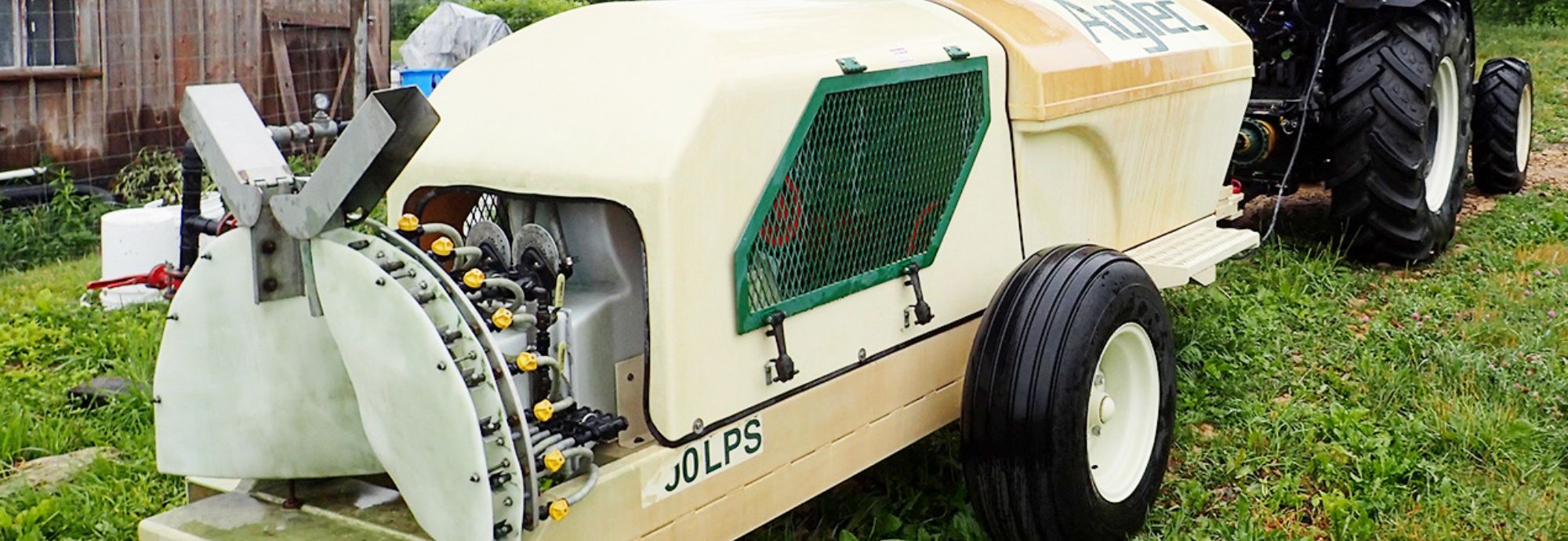
The most complex and costly system is an airblast or mist sprayer powered by tractors (see the resources section for non-tractor options). The tractor PTO powers the pump, which moves spray material to the nozzles. The tractor also powers a fan that blows air from behind the spray nozzles toward the crop, creating a fine mist that reaches into the tree canopy. The fan and pump require more horsepower than do the other options. Most airblast sprayers used in orchards have a spray manifold with multidirectional nozzles, but some models have “cannon” type volutes that direct the spray in one particular direction. If properly used and configured, airblast sprayers can deliver very uniform coverage, even in large, dense tree canopies. Many airblast sprayers have the option to attach a hose and handgun.
While many manufacturers produce airblast sprayers, they aren’t readily available at local farm supply stores or implement dealerships. Big John Manufacturing and A1 Mist Blowers are known for producing some lower-priced airblast sprayer models. Rears Manufacturing is a higher priced manufacturer that’s sometimes recommended to organic growers because their sprayers have a powerful mechanical agitation system that can keep kaolin clay and other products in solution. Many Midwest growers use AgTec sprayers that have a unique low-pressure system and differ in details of configuration and use from other higher-pressure sprayers. Airblast sprayers often cost well over $10,000.
Advantages: Most or all airblast sprayers have good hydraulic agitation in the spray tank from recirculated water. Rears pull-blast and pak-blast models have mechanical agitation from rotating paddles in the spray tank, which is particularly effective and eases mixing kaolin clay or other difficult products.
They are by far the fastest option, with spraying occuring at a tractor speed of 2.5 to 3 mph. When spraying mature fruit trees with vehicle-towed sprayer and a handgun, ground speed will be far slower; various growers estimated that spraying with a handgun triples or quadruples the time required. Handgun spraying also requires constant aiming of the handgun while driving. Consequently, most growers don’t consider it viable to spray a larger, mature orchard or berry planting this way.
Airblast sprayers provide very consistent spray output and coverage, provided winds are calm. They’re highly configurable – individual nozzles can be turned on and off and appropriate cores and tips can be selected to finetune the spray rate and distribution. Changing direction from right to left is easy, allowing an operator to change directions at the end of a row.
Limitations: It’s not practical to change spray rate and pattern on the fly. Many small organic fruit farms have a mix of crops, varieties, and ages of trees. Growers often configure their sprayer for the largest trees, which wastes some material when they spray smaller or younger ones. Since handguns allow for more directed application, consider spraying young trees with a handgun for the first few years, and then switch to an airblast sprayer as the trees fill in. Handgun sprays may also be less susceptible to wind drift.
Similar to tractor powered handgun sprayers, airblast sprayers are available as both three-point hitch and pull-type models. The former has 50-to-100-gallon spray tanks, with some models up to 200 gallons. Safety and stability are significant concerns with three-point airblast sprayers. A larger-sized compact utility tractor in the 35-50 hp range may be able to manage a 50 or 75 gallon three-point airblast sprayer, particularly if the tractor has a front-end loader to offset the weight of the rear-mounted sprayer. With larger spray tanks, you should be certain to confirm the capacity of your tractor.
The growers I’ve spoken with agree that airblast sprayers are not necessarily high maintenance. Like all sprayers, they should be flushed and rinsed thoroughly after use and filters should be kept clean. When airblast sprayers need maintenance, it’s likely that you’ll need to purchase parts from your dealer or an online supply store. It’s an advantage to have a remote dealer with the willingness and expertise to walk you through repairs over the phone.
Conclusion
What is the size cutoff at which an airblast sprayer becomes the only practical alternative? The answer depends on your personal tolerance for hand spraying, and how often you spray. In my experience with an organic dwarf apple tree orchard that has an intensive schedule of regular sprays, I would not want to use a handgun on more than a half-acre or acre of trees; however, other growers have sprayed up to five acres with handguns.
The proper choice for your orchard will depend on your scale, physical capabilities, plant sizes, and budget. Many growers use a series of sprayers as they progress from a small number of young plants to a larger scale farm with mature plants and as sales, tractor size, and mechanical aptitude increase. Whatever your choice, a smooth-running sprayer that allows you to spray quickly and effectively can seem worth its weight in gold!
Resources
Airblast101 - A free, downloadable, book which explains in details the physics, configuration, and use of airblast sprayers. https://sprayers101.com/airblast101/
A discussion of airblast sprayer options for small growers, including some non-tractor powered airblast sprayers. https://sprayers101.com/small-acreage/
An excellent resource from the University of Vermont which discusses sprayers as well as other equipment used on an organic orchard. https://www.uvm.edu/d10-files/documents/2024-06/Organic-Orchard-Equipment.pdf
Video that demonstrates using water sensitive paper to assess spray coverage. https://www.youtube.com/watch?v=P79fH2VdJic
AUTHOR BIO
Chris McGuire is coordinator of the Organic Fruit Growers Association (organicfruitgrowers.org), an organization of organic fruit growers, primarily in the Upper Midwest, which shares knowledge and advances research. Chris and his wife Juli also grow organic apples for their community at Blue Roof Orchard in southwest WI.