
By Ariana Abbrescia, Organic Transition Outreach Specialist, UW-Madison Extension
Publication
Winter 2026
“Managing vegetable pests and diseases organically can be challenging at times.”
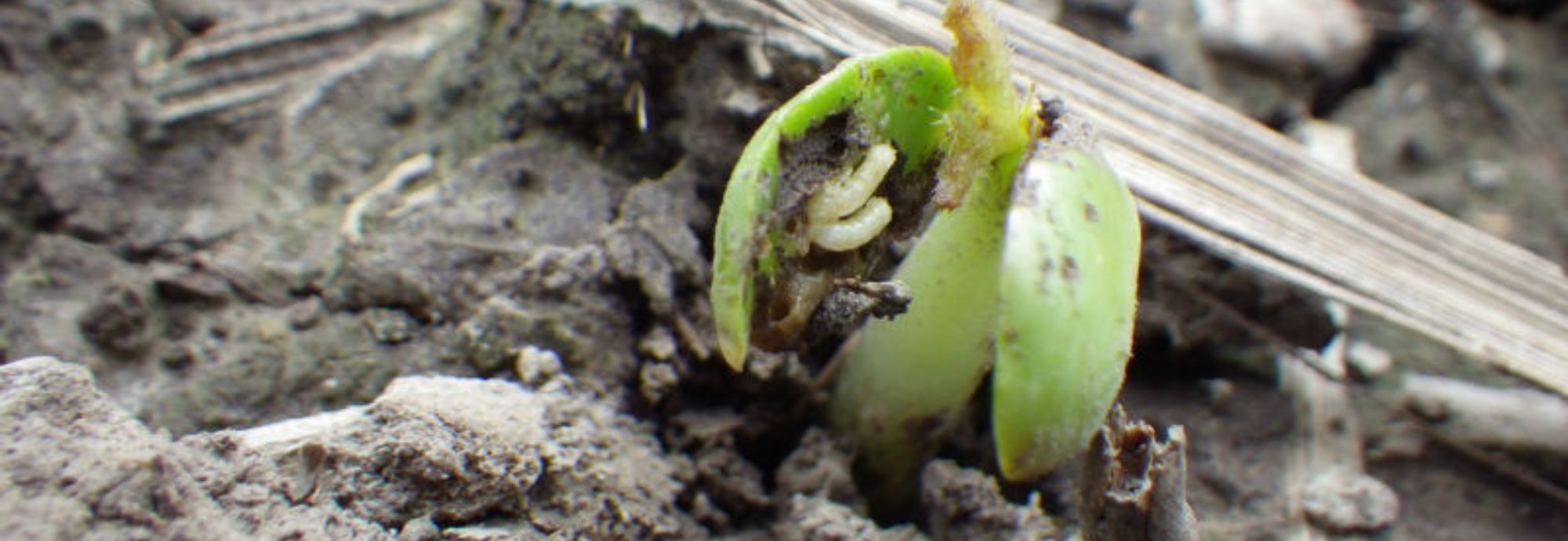
Most organic vegetable growers I know would say that’s the understatement of the year. Trying to manage pests and diseases with all the other aspects of farming can sometimes bring more questions than answers. Is this a disease or nutrient deficiency? Who munched my seedlings down to the ground? Sometimes we might not even know what kind of weird-looking bug we’re looking at. Is it friend or foe?
Specialists at UW-Madison like Dr. Russ Groves, Dr. Amanda Gevens, and Ben Bradford have been creating resources and tools to help tackle these problems, and I could talk about them all day! Or for 75 minutes, which we’ll be doing in a tutorial session at the 2026 Marbleseed Organic Farming Conference: “The Organic Vegetable Growers’ Virtual Toolkit for Pest & Disease Management.”
Growth Rates in Insects and Pathogens
The workshop will focus on one particular question: How do I manage pests and diseases when their patterns feel so unpredictable? To get there, we must start with a bit of science. Bear with me!
You and I, like other warm-blooded animals, have an internal temperature that stays relatively constant, even in our cold Midwestern winters. It’s a different story for insects; they’re cold-blooded, meaning they can’t regulate their body temperature. This means that insect development (think “caterpillar to butterfly”) depends on the temperature of their environment. They develop more slowly when it’s cold, more quickly when it’s warm, and may not develop at all below certain temperatures. Each insect species will grow at a different rate and will respond differently to changes in temperature.
It’s similar for pathogens—the microbes that cause disease on our crops. Different pathogens have different growth rates and unique responses to environmental conditions. Their development can be affected by things like temperature, relative humidity, and leaf wetness.
Know Thine Enemy
What does this mean? If we understand the relationship between a specific insect and the temperature of its environment, we can use temperature data to estimate how far along it is. Is it a caterpillar? A butterfly? Is it laying eggs? Is it munching on my cabbage? A pest or disease model does just this—it’s a mathematical tool that lets us use environmental data to estimate how far along an insect or pathogen is in its development.
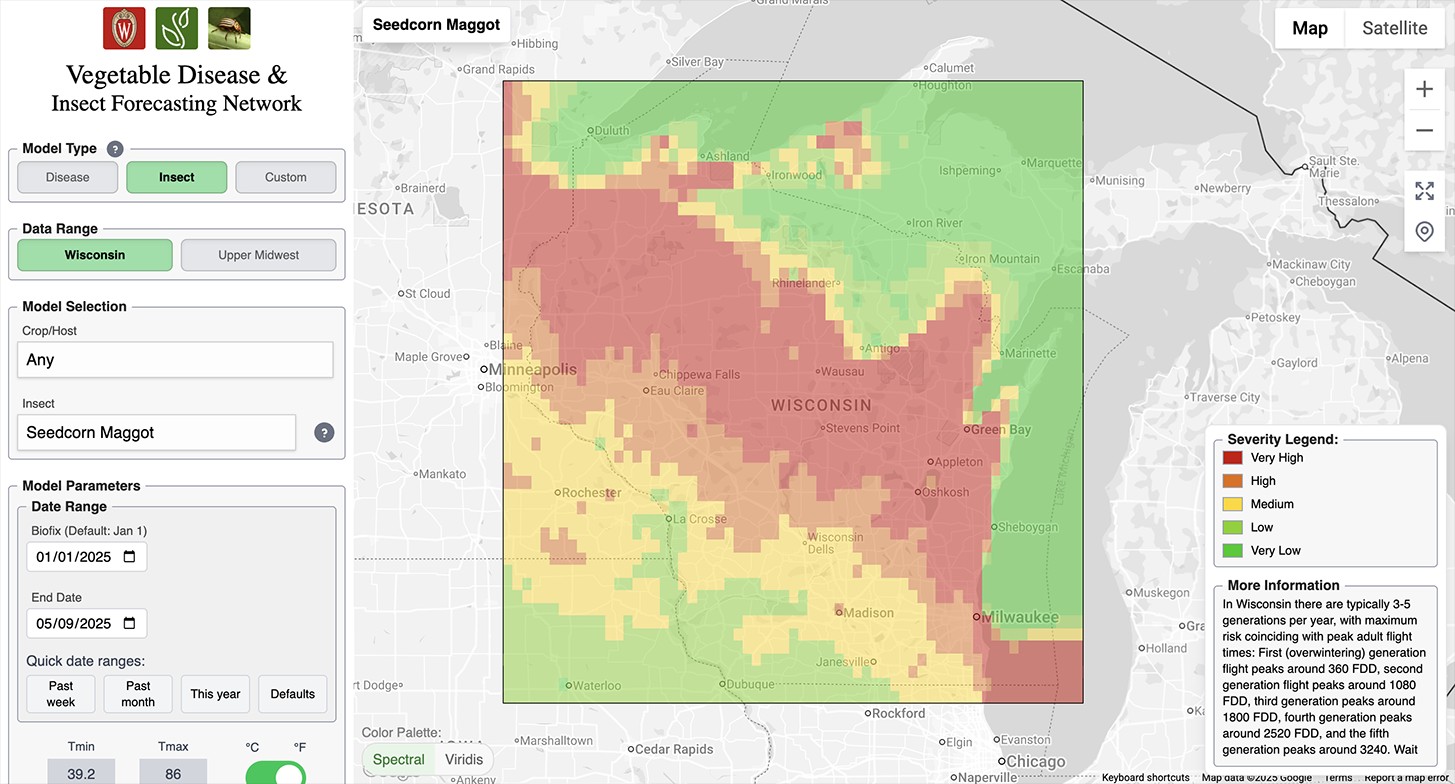
A better question: Why do we care? This is a classic case of “know thine enemy.” By understanding how pests and diseases develop, we can create tools for managing them. This is especially important in organic systems in which prevention, monitoring, and responsive management are key. Pest and disease models help give us pretty concrete answers to questions like “when is the highest risk for onion botrytis at my farm” or “when should I plant my sweet corn to avoid seedcorn maggots.” Because it accounts for year-to-year changes in temperature and conditions, answers are often much more accurate than using a fixed calendar date.
These models were originally calculated by hand—a great activity for math lovers! For folks who would rather do anything else, I have great news. The Vegetable Entomology and Plant Pathology programs at UW-Madison have created a series of online tools that take manual calculations out of the equation.
Free and Accessible Tools
The Vegetable Disease & Insect Forecasting Network (VDIFN) is an online tool that runs a variety of insect and disease models. VDIFN uses gridded weather data across the Upper Midwest to estimate real-time pest and disease risk at your farm, all on a slick map interface. While VDIFN shows us risk in the past and present, the newer Crop Risk Tool will take us into the future by forecasting risk, using hourly weather data and true 14-day forecasts. These tools are fully accessible on computers, tablets, and smartphones. Did I mention that they’re completely free to use?
If you want to learn more about how to use these tools, or the suite of other online resources and tools available through the UW-Madison Vegetable Entomology program, Vegetable Pathology program, Extension Crops & Soils program, and diagnostic clinics, join us at the Marbleseed Organic Farming Conference, Saturday, February 28th from 9:00 to 10:15 AM for “The Organic Vegetable Growers’ Virtual Toolkit for Pest & Disease Management.” We’ll walk through how to work each tool step-by-step using real-world examples, with plenty of time for questions, troubleshooting, and idea sharing. Bring your laptop, tablet, or smartphone to follow along. If you don’t have a device to bring, no worries, you’ll leave the session with printed guides and access to a pre-recorded VDIFN tutorial video.