
By Sara Mooney, Marbleseed
Publication
Winter 2026
Grass-fed meats have become a cornerstone of the diet of conscientious American meat eaters. Concerned about animal welfare, soil and water health, as well as the health benefits of eating pasture raised meats, Americans have come to accept pastured meat as a staple at the farmers market as well as the grocery store.
While pastured beef, chicken, eggs, and lamb are gaining traction in the American food landscape, pastured pork is less common outside of direct-to-consumer sales and a downright rarity in grocery stores.
For decades, the hog industry has been trending toward fewer but larger hog operations. According to the USDA’s Economic Research Service, between1990 and 2022, the U.S. went from exporting 2% of the global export of pork to 26% of pork on the global market. Most American hogs are raised in Concentrated Animal Feeding Operations (CAFOs). These corporately owned operations are now responsible for almost all (99%) American pork production.
Breeds like Duroc, Yorkshires, and Landrace are most often selected for use in CAFO pork production. These breeds mature quickly and produce a carcass type processors desire. The CAFO system’s ruthless efficiency speeds up growth rates and cuts labor costs at the expense of animal, environmental, and human health. Although the use of subtherapeutic antibiotics to promote rapid growth was banned in 2017, data from the Food and Drug Administration (FDA) shows that the amount of antibiotics fed to swine in this country has risen steadily since then. Antibiotics that were once routinely mixed in feed to promote growth are now fed with a veterinarian’s prescription to prevent disease.
There Is No One-Size-Fits-All Pig
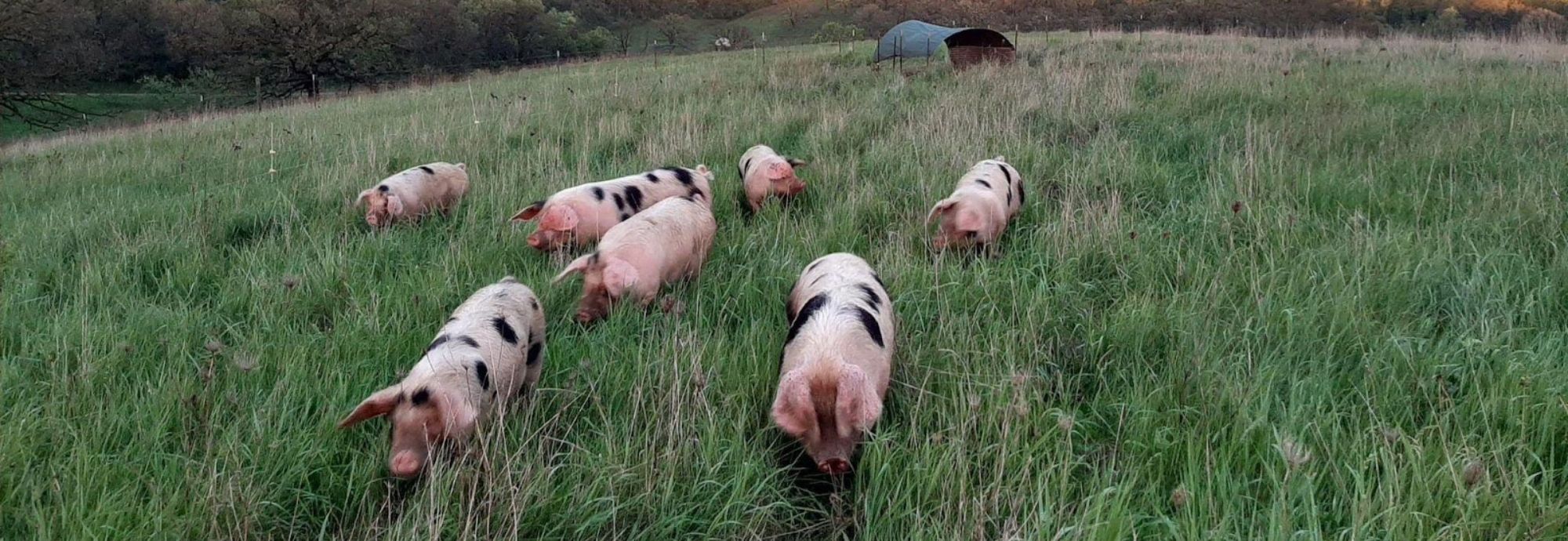
The life of a pastured pig at O’Connell’s Organic Acres in Durango, Iowa, or Dorothy’s Range in Blanchardville, Wisconsin, is a stark contrast to those raised in CAFOs. The hogs produced at these operations are heritage breeds raised on pasture. All the pigs at Dorothy’s Range are Gloucestershire Old Spots, while O’Connell’s cross breads large Black Hogs, Gloucestershire Old Spots, Berkshire, and Herefords. These heritage breeds, brought to North America by European explorers and immigrants, are known for their adaptability and hardiness. Farmers have selected traits over the course of hundreds of years that make hogs successful in their regions and environments.
While industrial hog raising operations utilize breeds that mature quickly and uniformly, these two farms are among the growing ranks of pork producers raising heritage breed hogs that are allowed to graze, forage, move about freely, and experience a natural social structure. These farms have developed systems that address the physical and psychological needs of the pig while working within their farms’ unique landscapes. There is no one-size-fits all approach when it comes to pigs on pasture, and pigs can be destructive to land if not managed well. Success comes from developing systems that embrace the challenges that CAFO systems have eliminated from hogs’ lives, including grazing, rooting, social interaction, injury, parasite pressure, dietary variation that may lead to varying outcomes per animal.
Pasture systems commit to raising healthy, strong animals with striking red flesh that make supermarket pork ill-advised if not inedible in comparison. As a result of young pigs getting more exercise, myoglobin, a protein in skeletal muscles that stores and transports oxygen, is present in higher levels in pasture raised pork. This creates meat that is redder and more beef-like in color and marbling (streaks of intramuscular fat) and improves the flavor and texture of the meat. Chefs and home cooks rave about the rich flavor of pastured pork, which is higher in protein and has healthier omega-6 to omega-3 fats. Research has shown that a lower ratio of omega-6 to omega-3 fats can reduce the likelihood of cardio-vascular disease and cancer.
Go Ahead and Wallow
Parasite control is an important consideration for all organic pork producers. While synthetic anthelmintics are allowed to treat animals in an emergency, organic pork producers must emphasize smart management to reduce parasite pressure. Here, pastured pork producers can gain an edge as their animals are less contained. O’Connell’s occasionally uses diatomaceous earth for parasite control. In Blanchardville, farmer April Prusia uses apple cider vinegar, garlic, probiotic feed, and black walnuts for parasite control. She relies on fecal egg counts to determine when to treat for parasites.
Rooting and creating wallows for mud bathing are natural instincts for pigs. O’Connell’s has accepted this and manages wallows as needed, occasionally filling one in that occurs in a problematic spot. At Dorothy’s Range, Prusia gives her pigs large tubs of water to create wallows where they are most appropriate.
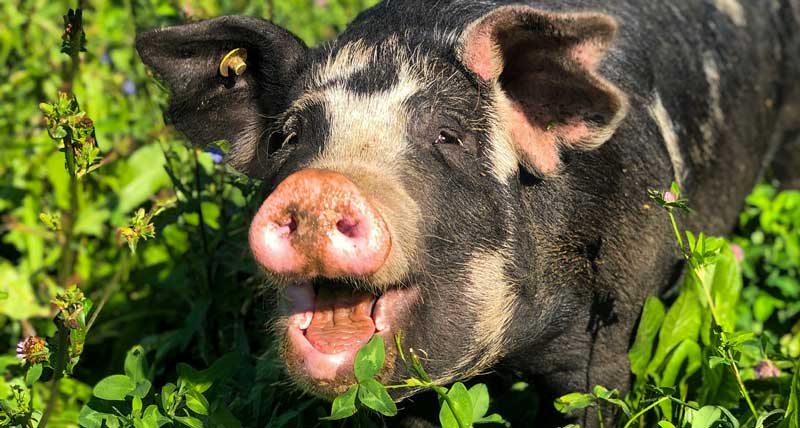
“I used to think wallows were destructive, but now I see them as miniature ecosystems that certain insects and wildlife utilize,” says Prusia. “I often see or hear chorus frogs using the pigs’ wallows. There are many studies showing that bison wallows create important wildlife habitat, and pigs’ wallows offer similar benefits.”
Both farms are selecting for pigs that work in their farmsteads. Prusia culls gilts (unbred female pigs) that prefer rooting to grazing and has found, over time, that her herd is more likely to graze. O’Connells alternates between purebred Berkshire GOS and Hereford boars bred to their mixed breed sows.
A common arrangement for grazing pigs is the “wagon wheel.” In this arrangement, animals have access to a central area in which damage is accepted and managed and where they are fed and watered. Several other, larger paddocks open off this central area. However, this arrangement isn’t practical on the hilly terrain of the driftless area.
Simple Fencing Solutions and Added Feed
These two farms have devised systems that work on their landscapes. O’Connell’s utilizes a home base method focused around the foundation of an old hog finishing building with alleyways that lead to paddocks that are fenced with two strands of electric. “Pigs respect the electric,” says Chris O’Connell, “and with sows, often one strand will do.”
Prusia also uses electric to create paddocks for her herd. She trains her pigs in a solid fenced area with a strand of electric just in front of the hard fence. Once the pigs learn that the electric fence is not to be touched, she can subdivide into smaller paddocks. The herd spends their summer grazing a hilltop. Additionally, Prusia trains her pigs to come to a feed bucket and her call. “If they ever escape, hunger and a familiar call make it easy to bring them back.”
As much as pigs enjoy the pasture, additional feed is necessary to raise marketable hogs. Both supply additional mineral blends. O’Connell’s, which also raises beef, lamb, and chicken, grows organic corn, soy (which is roasted), and oats for feed. Prusia adds roasted organic soybeans purchased from a neighboring farm, hay and haylage in cold weather, as well as walnuts from friends and neighbors who are happy to have them off their lawns. The pigs enjoy the nuts, husks and all, which, according to traditional medicine, is a powerful antiparasitic.
These two farms are succeeding in raising hogs without sacrificing the animals’ natural instincts, dietary, physical, and social needs. Their systems, while honoring traditional husbandry, are in no way old-fashioned. Prusia summed this philosophy up by saying, “Agriculture literally contains the word culture. As agriculture changes, so does our culture. Industrial, pharmaceutical-driven farming creates a culture disconnected from soil, seasons, and natural rhythms. But agriculture grounded in stewardship, soil health, and respect creates a culture that is healthier, more resilient, and more connected.”
Sara Mooney served as Marbleseed’s Conservation Outreach Specialist working on behalf of the Midwest Agriculture network in Wisconsin in partnership with the NRCS. This work was supported by a Cooperative Agreement with USDA Natural Resource Conservation Service. USDA is an equal opportunity provider, employer, and lender.