
Be Cognizant of Your Cation: Our favorite divalent cation in Wisconsin - Calcium!
By Dr. Nicole Tautges
Publication
Fall 2026
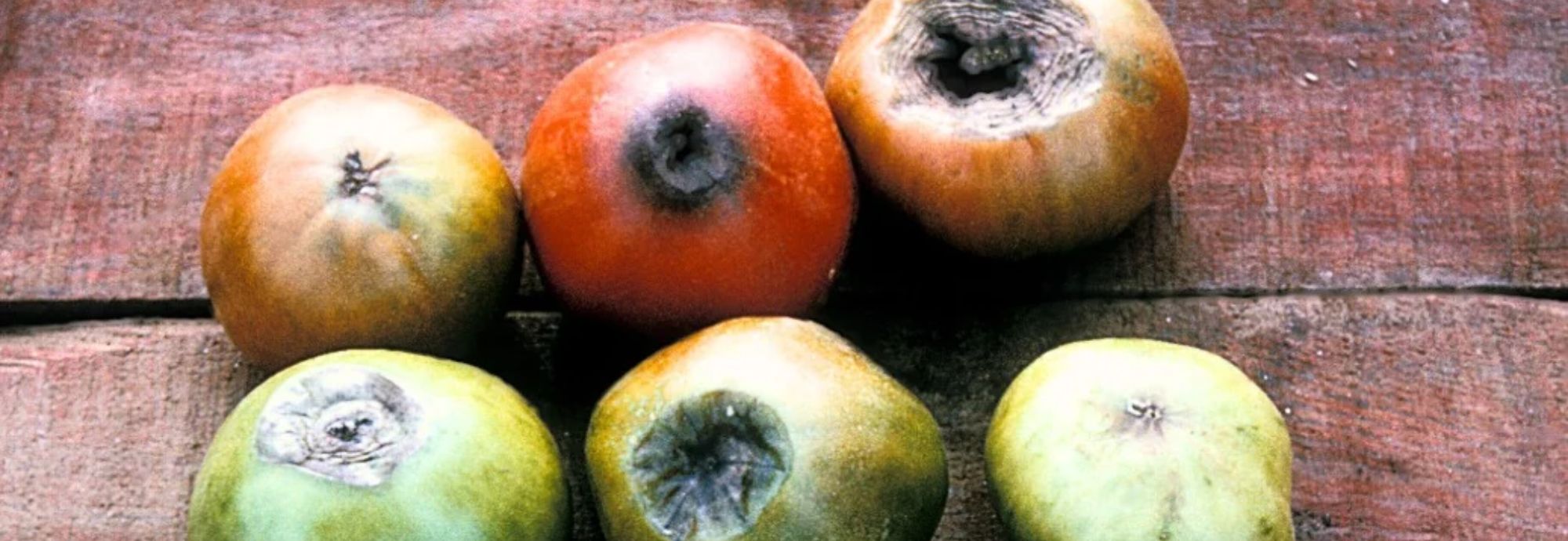
It happens at some point to everyone who has grown a tomato or squash – the icky black bottom. It looks perfect from the top, but then you turn it over and it is black right where the fruit meets the shriveled-up blossom, rendering the fruit unmarketable or unpresentable.
Blossom end rot is due to a calcium deficiency, where calcium availability or transport is lacking in the developing fruits (Joy and Hudelson 2024). As a young plant sciences student, I noticed this for the first time on a squash plant of mine. I did some light research to identify the problem and rescued it by applying leftover spoiled milk to the base of the plant.
While the milk worked (surprisingly!), it’s always better to consider calcium management in your soil fertility plan before planting.
Calcium deficiency
Most growers are aware of plant nitrogen requirements. There is less familiarity and discussion taking place around the cationic plant nutrients – calcium (Ca2+) and potassium (K+). Both are hugely important in determining the health of horticultural plants and, ultimately, fruit yield and quality.
In this article we are focusing on calcium, in honor of the full-full-full boxes of tomatoes coming off the fields as I write this. A future article will look at potassium.
Most calcium deficiency problems in horticultural plants occur in the areas of new growth on the plant and usually manifest as cell wall failure. This causes the flesh to break down and blacken. Blossom end rot occurs when new fruit growing from the fertilized blossom is not getting enough calcium from the mother plant.
Calcium deficiency can affect not just fruits but also leafy greens, producing blackened tips of otherwise beautiful leaves, and celery, where a lack of calcium can cause “blackheart,” or black necrotic areas in the middle of the celery bunch where the youngest growth is located.
Another reason to pay attention to the calcium levels in your soil and compost or other fertilizer amendments is that low levels of calcium can cause “cracking” in tomatoes, apples, and cherries. Cracking often occurs after heavy rainfall or water application, causing cells to swell. Without enough calcium to maintain cell wall integrity, the fruit cracks and rots (White and Broadley 2003).
Cellular memory
Calcium, which is part of the neurotransmitter release system in animal nervous systems, acts somewhat similarly in plants as a signal inducer, helping them respond to abiotic and biotic triggers in their environments. Some scholars have even likened calcium signaling systems in plants to a sort of “cellular memory” (Trewavas 1999), allowing them to alter their physiology and growth to adapt to their environments. This ability to alter growth and morphology in response to environmental factors is called “plasticity” (White and Broadley 2003).
Amazingly, calcium’s ability to bind or be chelated by six to eight oxygen atoms allows it to bind to proteins and change their conformation, or shape. Protein shape changes from chemical binding is a key biological process in signal transmission within plants that could only evolve (Sanders et al. 1999) because of calcium!
To provide just one example, plants change their growth in response to red and blue light shifts. These responses in plants occur because of rapid calcium signaling. White and Broadley (2003) have an amazing list of plant functions that occur from calcium signaling (see their Table 2). Have I convinced you how incredible calcium is?!
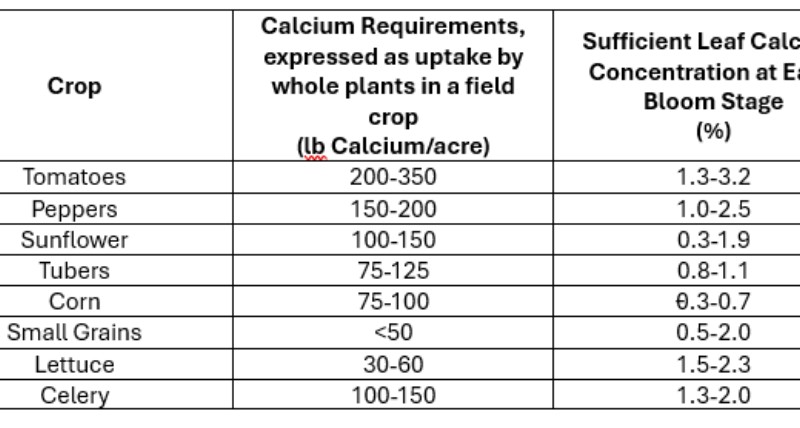
Table 1. Calcium optimal uptake rates at early bloom stage in various vegetables. Data supported by Westerfield et al. 2022 and Dutton 2025.
How to apply calcium
Back to practical matters! Regarding fertility management, calcium is not transported significantly in the phloem – the plant’s vasculature, or “bloodstream” – so foliar applications of calcium products are not as effective as applications to the roots. Calcium fertilizer application to the soil and root systems is the only reliable means of fertilization. Plant roots take it up and transport it in water in the xylem structure.
Excessive nitrogen and potassium fertility during the bloom and early fruit set stages can interfere with calcium going where it needs to go in the plant, namely to the new developing fruits. If excess nitrogen and potassium result in too much vegetative growth, then calcium is diverted to new leaf and stem structures rather than to the fruit, resulting in blossom end rot and fruit quality degradation (read more about this in Westerfield et al. 2022). It is best to keep nitrogen fertilization pre-plant or during the vegetative stages of growth, before blossoming and fruit set.
Additionally, calcium can only move to and through the plant in water, so if a soil tests sufficient for calcium content but a plant is showing deficiencies, it may be due to a lack of watering. Watering properly during blossom and early fruit set can alleviate blossom end rot and other calcium-related conditions. Leaf curling in pepper and tomato is a response to low calcium, but also an indicator that more water is needed. Watering in this case will likely alleviate the leaf curling and calcium deficiency.
Know your soil pH!
Lime, bone meal, and compost high in eggshell feedstocks are all great fertility sources and amendments for ensuring proper calcium availability to vegetables. There are many ground limestone, calcitic lime, and dolomitic lime-based products that are OMRI approved. Be aware that there are a few lime-based products that are not OMRI-approved, so be sure to read labels and discuss with your certifying agency.
Soil pH is almost always a regulator of nutrient availability, so be sure to test and know your soil pH. Calcium deficiency is a common problem in highly acidic soils with pH under 5.5. In soils with pH greater than 7.5, calcium gets adsorbed by carbonates to form calcium carbonates and other precipitate deposits in soils; these carbonates are not readily available for uptake by plant roots.
Soil tests for calcium will typically report in ppm but most analytical labs have sufficiency ranges on their results reports. Compare your category (e.g., “very low” or “low”) with the above uptake amounts listed in Table 1 for the crop in question to estimate fertilizer application rates.
Bottom line: know your soil pH. Apply corrections to get it between 6.5 and 7.5. Your plants will almost certainly improve across the board!