
Weighing the Costs of Organic Certification
Published: Jul 2026
By: Katie Witt, Kathleen Delate
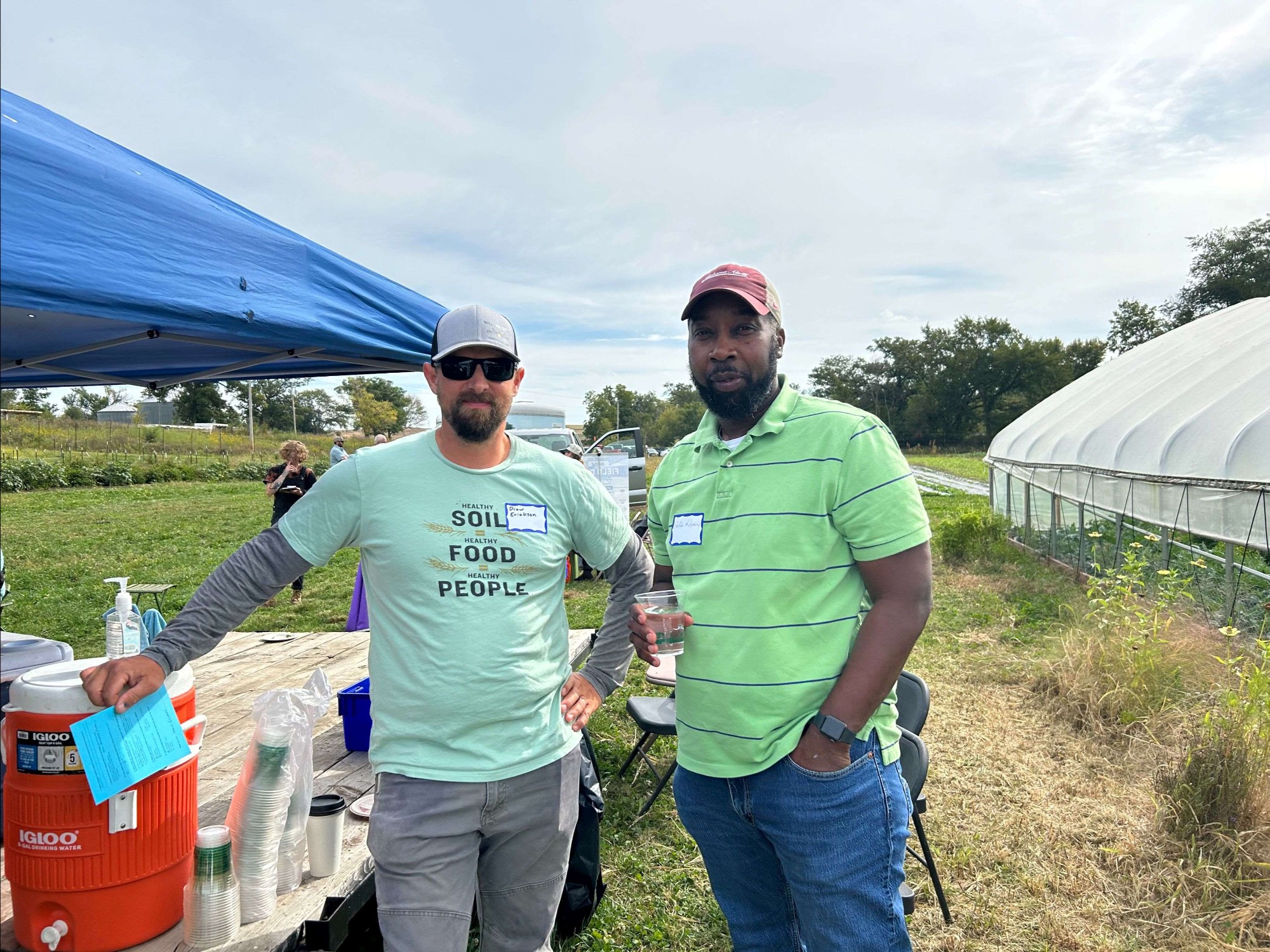
Shaffer Ridgeway, who operates Southern Goods just outside Waterloo, Iowa, is approaching a pivotal moment as he transitions his two-acre vegetable farm to organic certification through the USDA's Transition to Organic Partnership Program (TOPP). With guidance from mentor Drew Erickson of Rodale's Midwest Organic Center, Ridgeway values the benefits of operating an organic system, including improved soil health and reduced reliance on synthetic inputs.
While Ridgeway – pictured above on the right with mentor Drew Erickson of Rodale's Midwest Organic Center – honestly acknowledges the financial investment required for certification, which is about $1,400 in the first year plus ongoing recertification fees, he remains optimistic about the long-term advantages it could bring. “In my current market, I don't believe organic certification delivers more sales,” Ridgeway explains, reflecting on his trust-based relationship with customers that has allowed Southern Goods to thrive without formal labels. However, he understands that as he shifts focus towards wholesale markets, certification can drive sales by offering added credibility. “When I've got a warehouse full of produce, and I'm dropping off to grocery stores, that's when organic really comes into play,” he adds.
However, transitioning to wholesale requires more than organic certification. Ridgeway notes that adequate cold storage, efficient transportation, aggregation, and consistent buyers are all essential to scaling up and starting wholesale sales. This infrastructure is crucial for fully realizing the benefits of organic certification.
While wholesale markets are increasingly appealing to him, Ridgeway is dedicated to regional food systems and has little interest in shipping products over long distances. “I'm a regional food guy,” he emphasizes. “As soon as those greens leave the vine, nutritional value starts to decline. The farther it travels, the more you lose nutritional benefits.” Though he wants to scale up to wholesale, he acknowledges that the associated costs are prohibitive.
Fortunately, some support is available to help alleviate the high costs of transitioning. The Organic Certification Cost Share Program, funded by the USDA, helps organic farmers by reimbursing up to 75% of eligible certification costs, up to $750 per year. While this program is crucial for making organic farming more feasible for small-scale farmers, it has faced delays due to funding gaps at the federal level. Although recent payments are pending, the USDA anticipates the program will resume soon.
Shaffer Ridgeway's experience sheds light on an overlooked issue in organic agriculture: organic certification alone does not guarantee increased profitability, especially for small, community-centered farms. Certification must align with scale, infrastructure, market access, and government support to truly make sense for farmers. As Ridgeway prepares to apply for certification, he is eager to see how this strategic move to organic can positively impact his farm and expand market access in the coming years.
Shaffer has used resources from the ISU Organic Program to assist with the transition, including publications on Pest Management and Navigating Government Regulations. The ISU Organic Program is supported by the USDA Transition to Organic Partnership Program (TOPP).
The ISU Urban Ag Project is committed to building the knowledge, relationships, and infrastructure that urban farmers need to thrive. To learn more about urban agriculture or explore potential ways to grow in an urban setting, visit the program website or contact Katie Witt, Organic & Urban Ag Program Specialist, at kwitt@iastate.edu.
This article was republished with permission from Iowa State University Extension and Outreach.