
Parasite Outbreak Shows Need for Local, Organic Food
Published: Sep 2026
By: Lori Stern
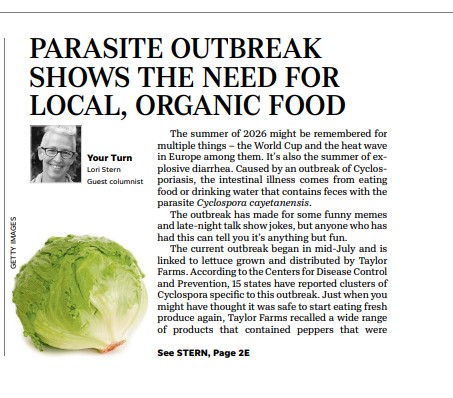
In her OpEd, which you can access
HERE
(though it's behind a paywall), Stern points to two major problems at the heart of the outbreak – consolidation and federal cuts.
The first has allowed companies to completely dominate entire sectors — whether it's Driscoll's and berries or the “Big Four” meatpacking giants. In the instance of salad greens, many of us just got a crash course in the reach of Taylor Farms. (Hat tip to our friend Austin Frerick, a two-time speaker at Marbleseed's Organic Farming Conference, and his crucial work in agricultural antitrust policy.)
As Stern writes: “Even if you’d never heard of Taylor Farms before the summer of 'diarrhea lettuce,' you’ve eaten their produce. According to the company’s website, 'Taylor Farms is now the leading global producer of salads and healthy fresh foods, with production facilities across the U.S., Canada, Mexico, and Western Europe.' Its bagged produce is labeled under many names, including Kirkland Signature (Costco) and Trader Joe’s. The company provides bulk shredded lettuce to McDonald’s, Subway, Olive Garden, and many other fast-food chains.”
In other words, it's really hard not to eat their product. You might try to avoid it, but you'd need to be a hardcore investigative reporter to catch every instance of it.
The other culprit are the federal cuts that the food and ag sectors have been taking since the beginning of the current administration. We're familiar with the direct cuts to funding for farmers, but many of us were less aware of cuts to inspection and other roles that keep our food system safe. Departments and programs charged with tracking, preventing, and communicating information related to foodborne illnesses have all experienced drastic personnel cuts.
There is no one answer to fix this situation, though breaking up monopolies and providing ample funding are clearly needed. Part of the solution Stern points to is the role that local foods can play in keeping us safe. While organic food can carry Cyclospora and Salmonella, the difference is that food grown on a much smaller scale and not shipped to points in the supply chain where it comingles with product from other parts of the country are much less likely to take on these parasites. There is far greater oversight of who is growing the food and under what conditions.
Stern ends by reminding us of the strong system of small, organic, and sustainable farms in Wisconsin, a state that has long been a leader in organic agriculture. “We rank second in the nation for total certified organic farms, with more than 1,400 operations,” writes Stern. “It is a network that we can not only be proud of but should protect and promote.”